 Add us as a preferred source
The NHS wants every hospital to be AI-enabled – but algorithms are only as good as the data behind them. h-trak explains why the AI conversation needs to start with better data capture at the point of care.
AI is rarely out of the healthcare headlines. It is being used to support diagnostics, reduce administration, improve productivity and help organisations make faster, better informed decisions.
The NHS has placed it at the heart of its plans for the future. Its 10 Year Health Plan includes a major shift towards the digital approach and sets an ambition for every hospital to become AI enabled over the lifetime of the plan.
But the conversation about AI should start one step earlier: AI can only produce meaningful insights if the data it relies on is accurate, complete and reliable.
While this sounds obvious, as NHS and private healthcare organisations invest in increasingly advanced technology, it is worth asking a much simpler question:
Do you have the right data to support it?
Healthcare organisations generate vast amounts of data every day, but not all of it is captured in a useful format.
Picture a typical procedure. Consumables, implants and medical devices may be used, each with its own product details, cost and traceability information.
In some clinical areas, those items are still written down by hand. The record might be completed during the procedure, or afterwards from packaging and memory. The same information may then need to be entered again into multiple systems.
It only takes one missed product or incorrect entry to create a gap:
- The stock system may show an item that is no longer on the shelf.
- The cost of the procedure may be incomplete.
- An implant may not be digitally linked to the patient who received it.
- If that product is later recalled, finding the affected patient can become a time-consuming task.
These are not future problems created by AI. They affect stock visibility, traceability, purchasing, costing and staff time today.
Adding AI further down the line will not make those gaps disappear. No algorithm can analyse information that never made it into the system.
Better AI starts with better data capture
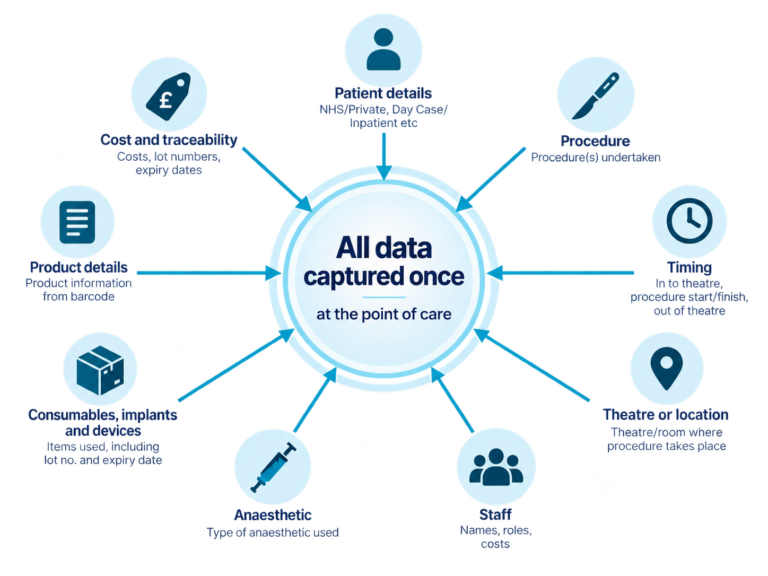
The most reliable data is captured at the moment the activity takes place as it minimises the risk of incorrect data entry.
Point of care barcode scanning is one way of making that happen, and it is where h-trak can make a difference.
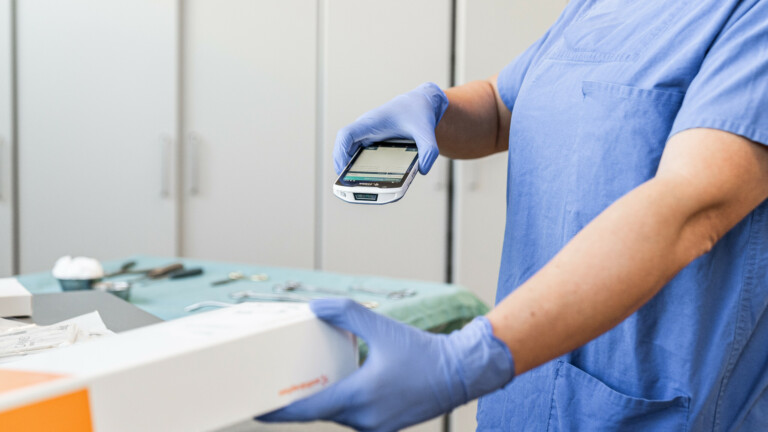
h-trak allows clinicians to scan consumables, implants and medical devices as the procedure takes place. Adopting data capture as part of the clinical workflow and reduces the reliance on staff remembering and recording information afterwards.
Each scan creates a digital link between the product, patient and procedure. It can also capture details including the product code, lot or serial number, location, time and cost.
The aim is not to collect information simply because it might be useful to AI one day. It is to create an accurate record of what has happened, providing clinical, procurement and finance teams with information they can use today.
At the same time, every completed record contributes to something increasingly valuable: a structured and dependable source of data for future analysis.
The value of this becomes particularly clear during high-risk events such as a product recall. At University Hospitals of Derby and Burton, a potential CJD contamination incident could previously require at least 50 hours of manual patient note reviews for each patient, without complete confidence that everyone exposed had been identified. Using the electronic records captured through h-trak, all affected trays, patients and staff can now be identified in around 30 minutes, enabling faster responses with greater confidence in the findings.
From what happened to what happens next
Once information is captured consistently, healthcare organisations can start asking more useful questions.
Why does one surgeons’ procedures cost more than another? Why is a particular product used more frequently in one area? Where is stock sitting unused? Which items are at risk of expiring? What is likely to be needed next month?
Over time, AI could make it easier to analyse activity at scale, identify unexpected variation and forecast future demand. But those insights will only be meaningful if they are based on a complete picture of what is actually happening.
By capturing products at procedure level, h-trak helps build that picture. It turns individual scans into a detailed history of product usage, costs and clinical activity, providing a stronger starting point for both everyday reporting and more advanced analysis.
Before organisations can confidently predict what will happen tomorrow, they need to understand what is happening today.
One scan, several answers
The value of accurate data capture extends beyond AI.
When a product is scanned through h-trak, that one action can support several teams.
For clinical teams, it creates a traceability record and makes it easier to identify affected patients during a product recall.
For procurement, it provides a more accurate view of consumption, stock levels and replenishment requirements.
For finance, it contributes to a clearer understanding of procedure costs and helps identify products that may otherwise have been missed from billing or reimbursement.
Through integration and interoperability, a single scan creates a shared record that can be used across systems and teams, reducing duplicate data entry and improving visibility across the organisation.
The work behind the headline
AI may be the most visible part of digital transformation, but its success depends on accurate, structured data that reflects what happens at the point of care. h-trak helps create this foundation through everyday clinical activity, improving traceability, inventory management and procedure costing while preparing organisations for future technology. The NHS’s AI ambitions will not begin with an algorithm, but with capturing the right information, at the right time, at the point of care.
To find out more about how h-trak is being used in practice, you can get in touch with the team.
+44 (0)330 127 6240
[email protected]