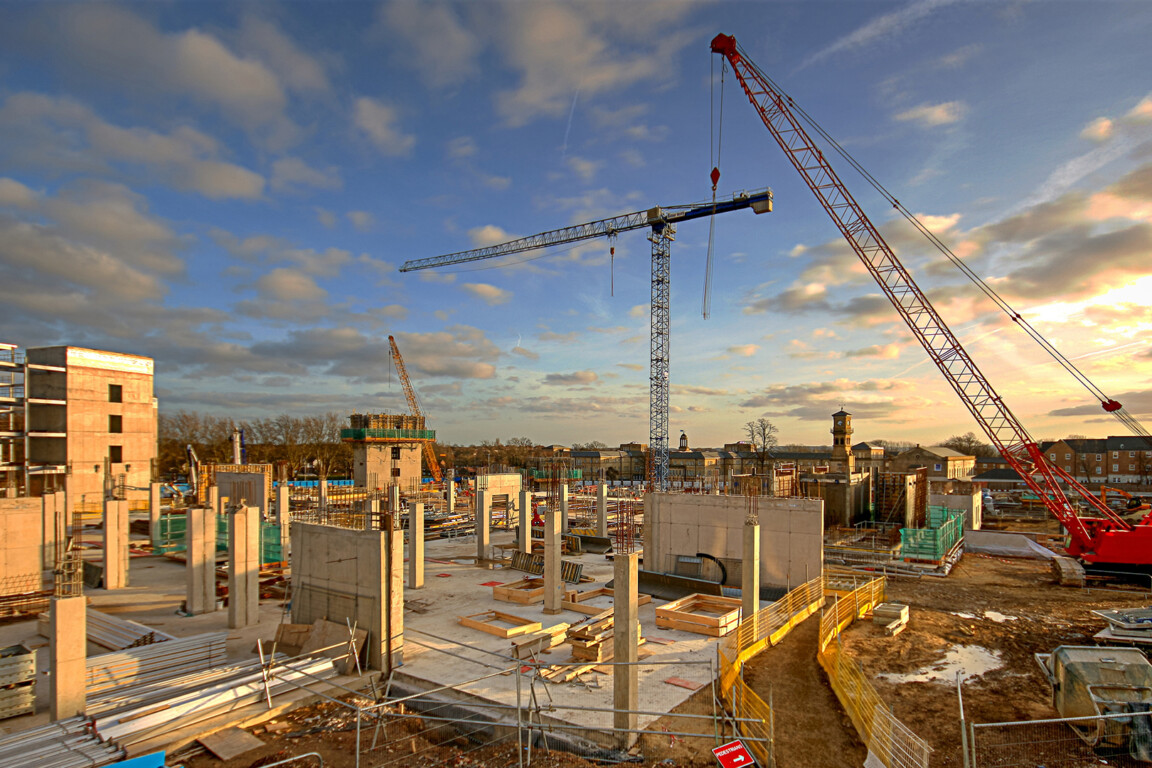
Although the government’s New Hospital Programme has been put on a more realistic timetable, problems are still expected with delivery.
Although the government put the New Hospital Programme (NHP) on a more realistic timetable last year, and the replacement schemes for hospitals built with reinforced aerated autoclaved concrete (RAAC) are now expected in 2032–2033, a tight construction schedule overall with little contingency in the next five years means that the National Audit Office (NAO) believes that there are significant delivery risks.
The new timetable, described by health and social care secretary Wes Streeting in January last year as “an honest, funded and deliverable programme”, was detailed out to the end of 2040. The aim is, as Morag Stuart, chief programme officer for the New Hospital Programme, said, to provide “certainty”.
The independent public spending watchdog has published an update following its 2023 report and the Department of Health & Social Care’s (DHSC) decision to reset the programme after reviewing the timetable and costs.
The reset covers 41 hospital schemes, which range from whole new buildings to major refurbishments, and will be carried out in four waves over the next 20 years. An additional five schemes were already complete and open when the programme was reset last year.
The final hospitals are expected to be completed in 2045. Although DHSC carried out an analysis to rank the schemes, it ultimately prioritised schemes which were furthest advanced, and any smaller projects it could afford within its spending review settlement.

Significant need for capital funding
The NAO says that the government has allocated around £2 billion a year to the programme from 2025 to 2029, rising to £3 billion a year from 2030. It estimates that a total capital funding of around £56 billion will be required. More realistic planning assumptions mean that this is a £33.8 billion increase on the capital funding proposed in 2023. DHSC has built in a £12 billion contingency (21%) to reflect inflation, market pressures, engineering challenges and environmental requirements.
An independent 2022 report recommended that the seven hospitals predominantly built from RAAC should be replaced by 2030 at the latest. While DHSC has prioritised these in its revised plan, they will not be replaced by that date. A further report published in December concluded that, with mitigations and sustained maintenance, these hospitals can remain operational beyond 2030. However, these hospitals will face significant costs and operational risks, including safety risks to patients.
By the end of the past year, the seven hospitals had required more than £500 million of investment to prevent structural failure.
Trusts whose new hospitals or refurbishments will open later will face additional costs to maintain ageing buildings for longer – estimated by DHSC at between £100 million and £140 million a year.
Patients cannot wait a decade
Since the new plan and funding commitments were announced, the programme has had expressions of interest from more than 20 potential main contractors and is taking 16 pre-qualified bidders through competitive dialogue to help them develop solutions and technical specifications prior to submitting final tenders.
The construction schedule over the next few years is challenging as hospital schemes adapt to the new approach. If early schemes fall behind, there are risks of delivery dates slipping, and work may bunch up later. This could lead, the report says, to budget pressures on later hospital waves.
The NAO has recommended that the DHSC and the New Hospital Programme maintain rigorous programme oversight to keep delivery on track, learn lessons between schemes and respond to changes in healthcare needs. They should also strengthen long-term cost estimates and align delivery and funding profiles, weighing any acceleration of schemes against delivery risks, industry capacity and price pressures.
The news of the difficulties with construction has frustrated the medical community.
“A steadier plan is better than drifting, but patients cannot wait a decade for capacity that we need now,” said Tim Mitchell, president of the Royal College of Surgeons of England. “Unless we fix capacity with further capital investment, the waiting times target will stay out of reach,” he added.