David Davis, chief clinical information officer and paramedic at London Ambulance Service NHS Trust, explains what the service’s AI trial reveals about healthcare innovation.
The NHS never struggles to come up with new ideas. What we struggle with is putting them into practice in ways that genuinely improve care.
That distinction matters, especially as artificial intelligence moves from pilot projects into everyday clinical work. Ambient voice technology, which converts conversations into structured notes, is a prime example. The real test is whether healthcare systems can adopt it properly.
Across several NHS settings, recent evaluations of ambient voice tools show measurable improvements. A large multi-site study led by Great Ormond Street Hospital found that clinicians using AI-supported documentation spent less time on admin and more time with patients. Many reported that they could focus fully on the conversation instead of splitting their attention between a patient and a screen.
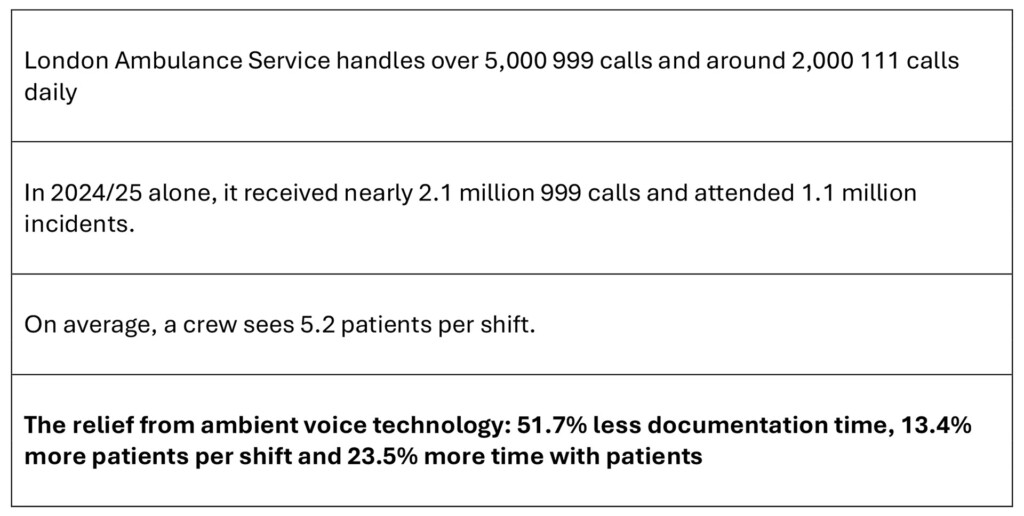
At London Ambulance Service, early use of the technology on the frontline and in clinical hub settings – where paramedics and nurses provide remote assessment and advice for callers and crews – produced similarly encouraging results. Paramedics found they could complete documentation much faster and spend more time treating patients. Some saw documentation time reduced by more than half. That matters in a service where every minute saved means a faster response for the next person waiting for help.
What surprised us most was how well the technology worked in real environments. We tested it in noisy, unpredictable situations and it performed far better than expected.
Why adoption is harder than innovation
Despite these results, rolling out new technology in healthcare is never straightforward. Many clinicians have seen systems introduced that promised efficiency but delivered additional burden instead.
Digital tools have sometimes felt like something clinicians had to work around rather than with. People still remember when consultations involved looking at the patient first and writing notes afterwards. Now it can feel like a balancing act between patient and keyboard. That history shapes how new technology is received.
Ambient voice technology can change that dynamic, but only if introduced thoughtfully. It is not just a transcription tool. It impacts how clinical information is captured, structured and reviewed. Making that work means agreeing on standards, integrating with existing systems and ensuring clinicians remain fully in control of the final record.
One lesson we learned early on involved what clinicians call “impertinent negatives”.
In clinical documentation, not mentioning something is not the same as examining it and recording a negative finding. The danger is that if an AI system records that something was not discussed, this may be interpreted by another clinician or another digital system as evidence that it was assessed and ruled out. We saw examples where AI-generated notes and templates we created implied a symptom had been excluded simply because it was not spoken aloud. To address this, we adapted both the technology and our clinical practice. Documentation templates were refined, prompts were adjusted, and all AI-generated notes continue to be reviewed and signed off by a clinician. Adoption is not just about deploying software; it is about ensuring the system supports safe clinical reasoning.
When we rolled out the pilot of this technology at London Ambulance Service, we saw a different pattern of adoption. Clinicians have been keen to use the technology, and actively tell us when it is not available. In collaboration with other ambulance services, we have shared lessons from the pilot to support wider adoption across the country.
Trust is essential when introducing any new technology into healthcare, particularly AI. These systems can occasionally produce inaccurate outputs, and in patient care, accuracy matters. The answer is not to avoid innovation. It is to put the right safeguards in place that work as part of the clinicians’ workflows.
National guidance is increasingly clear that organisations must establish strong governance, privacy protections and clinical oversight before scaling AI tools, and that these systems should be properly integrated. Clinicians must remain responsible for records, and systems must be designed to support professional judgement rather than replace it.
Staff are far more willing to embrace new tools when they understand how they have been tested, how risks are managed and what happens if something goes wrong.

Keeping the human in the loop
When adoption is done well, the benefits go beyond efficiency. Clinicians describe feeling less mentally overloaded, particularly at the end of long shifts. Instead of trying to remember every detail of a complex interaction, they can focus on listening and assessing while the system captures the information. That can make a real difference in high-pressure environments such as emergency care. Careful consideration is essential to ensure that the clinician stays in the loop at all times, and that requires working with and training clinicians.
Emergency services include many neurodivergent professionals whose strengths often lie in rapid decision-making, situational awareness, and working under pressure. Complex documentation systems can slow them down. Within the pilot of ambient voice technology, we found anecdotally that the positive impact for neurodivergent colleagues was even more significant. By reducing administrative friction, ambient voice technology helps clinicians focus on patient care and work at their best.
AI will transform healthcare, but not simply because it exists. It will do so only if organisations learn how to implement it safely, responsibly and with clinicians at the centre of the process.
The experience at London Ambulance Service shows what is possible when new technology is tested in real conditions, introduced carefully and shaped by the people who actually use it. The lesson is simple: innovation alone does not improve healthcare. Adoption does.
David Davis will be speaking about improving adoption, quality and productivity with ambient voice technology at Digital Health Rewired, taking place 24 and 25 March at the NEC Birmingham. Find out more at https://digitalhealthrewired.com/