Add us as a preferred source
On the face of it, higher clinical success rates seem bad for clinical research organisations. Not always. Managing partner Dr Leonid Shapiro shares Candesic’s research into AI’s impact on clinical trials and the implications for investors.
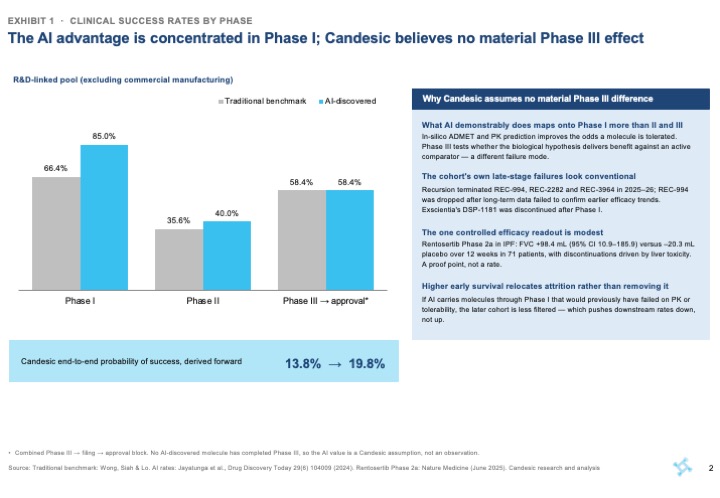
Molecules discovered using artificial intelligence are clearing Phase I at rates of 80–90%, against a traditional benchmark of 66.4%. In Phase II, they post around 40% against 35.6%. Those figures, assembled in a 2024 analysis in Drug Discovery Today, are the best evidence available that computational drug design is translating into clinical outcomes.
This looks bad for investors in clinical research organisations (CROs) and the wider outsourced pharma-services market. CROs are paid to run trials, including trials that ultimately fail. If fewer compounds fail, does that mean less work for CROs?
A failed molecule may generate some trial activity, but it does not generate the later-stage work that follows a successful programme. Improved survival increases the number of programmes that reach the more expensive stages.
Start with the right benchmark
The size of the apparent AI advantage very much depends on what benchmark is used. Compared with the BIO/Informa/QLS dataset, which tracks novel drugs in their lead indication and puts Phase I success at 52%, the AI uplift looks enormous. Compared with the larger Wong, Siah and Lo dataset – over 400,000 trial records, and the benchmark the current equity research on this sector uses – Phase I success is already 66.4%, and the uplift roughly halves. Candesic uses the second because it is the larger dataset, because it defines success as phase progression in the same way the AI cohort figures are constructed, and because it provides the more conservative basis for our analysis.
On that basis, the Phase I advantage is real but more modest than advertised: roughly a 28% relative improvement, substantially below the near-doubling circulating in some of the trade press. The Phase II advantage – 40% against 35.6% – is difficult to interpret given the very small sample of around ten molecules, and a 2026 re-analysis of the same evidence base describes it as statistically indistinguishable from conventional development.
Why we assume no Phase III effect
No AI-discovered molecule has completed a Phase III trial.
Every published end-to-end probability of success for AI-discovered drugs is therefore a modelled figure that applies historical late-stage rates as an assumption. Rather than quote one of those numbers and reverse-engineer what sits inside it, we therefore assume that Phase III and regulatory success for AI-discovered molecules is held at the same level as non-AI compounds. On that basis, the end-to-end probability of approval rises from 13.8% to 19.8%.
There are three reasons to take a cautious view of any late-stage difference.
The areas where AI has demonstrated an impact so far are more relevant to Phase I than Phase III. In silico prediction of absorption, distribution, metabolism, excretion and toxicity improves the odds that a molecule is tolerated in humans. Phase III asks a different question: whether a biological hypothesis delivers benefit against an active comparator in a broad population, and the sources of failure are also different.
In addition to this, the cohort’s own late-stage failures look entirely conventional. Recursion terminated REC-994, REC-2282 and REC-3964 across 2025 and early 2026, dropping REC-994 after long-term data failed to confirm earlier efficacy trends. Exscientia’s first clinical compound, DSP-1181, cleared Phase I on safety and was then discontinued without progressing. These are efficacy and viability failures of exactly the kind that has always dominated late-stage attrition.
There is also a selection effect that could work in the opposite direction. If AI carries molecules through Phase I that would previously have failed on pharmacokinetics or tolerability, the cohort arriving in Phase II and Phase III is less filtered than before, not more. Higher early survival may move attrition later rather than eliminate it.
Previous advances in drug discovery provide some support for this view. High-throughput screening, combinatorial chemistry, structure-based design and genomics each improved the front end of discovery without moving late-stage attrition, and genomics was sold explicitly as a target-selection fix. Candesic’s view is that any Phase III difference is likely to fall within plus or minus 10% in relative terms and is more likely negative than positive in the near term. We should have better evidence over the next 18 months as rentosertib and RLY-2608 reach pivotal readouts.
What that does to volume
Consider 1,000 Phase I starts under the two scenarios by way of illustration. Assume half of all molecules entering the clinic are AI-discovered and that sponsors keep the number of Phase I starts constant. Phase I volume is unchanged. Phase II starts rise 14%. Phase III starts and approvals rise 22%.
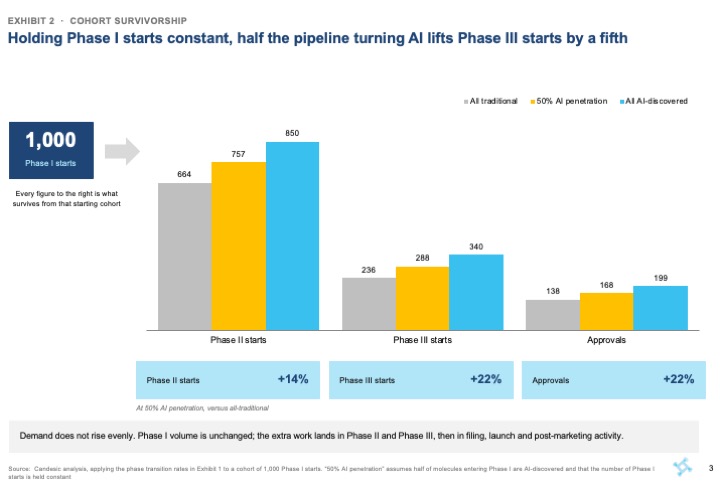
The additional demand lands mostly in the later stages, where cost and outsourcing intensity are higher.
Where the demand lands
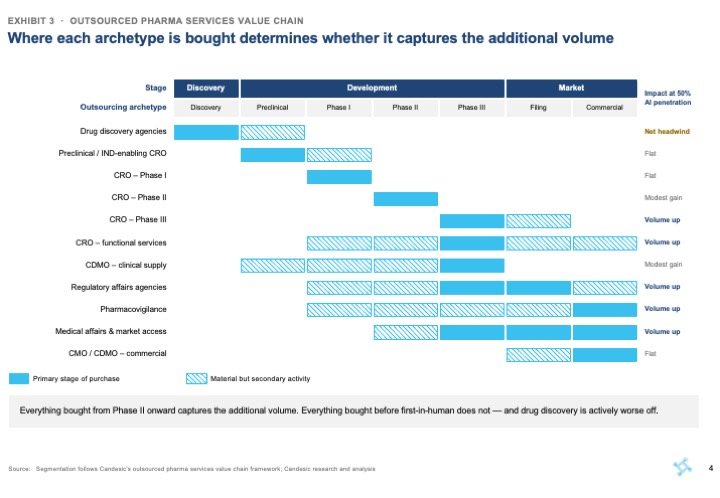
Outsourced pharma services are stage-gated. Discovery agencies, preclinical CROs, phase-specific clinical CROs, functional service providers, CDMOs, regulatory affairs agencies, pharmacovigilance providers and medical affairs and market access consultancies are each bought at an identifiable point in the development lifecycle, and several are bought materially across more than one.
Applied to market sizes, this is what the shift is worth. Candesic sizes the R&D-linked outsourced pool at around $175 billion, alongside a commercial manufacturing market of roughly $165 billion. At 50% AI penetration with Phase I starts held constant, incremental demand across the R&D-linked pool is about $27 billion, a 15% expansion. Phase III CRO work takes $7.6 billion of that, clinical-supply CDMO $5.3 billion, and functional services – central laboratory, sites and recruitment, biometrics – a further $4.7 billion.
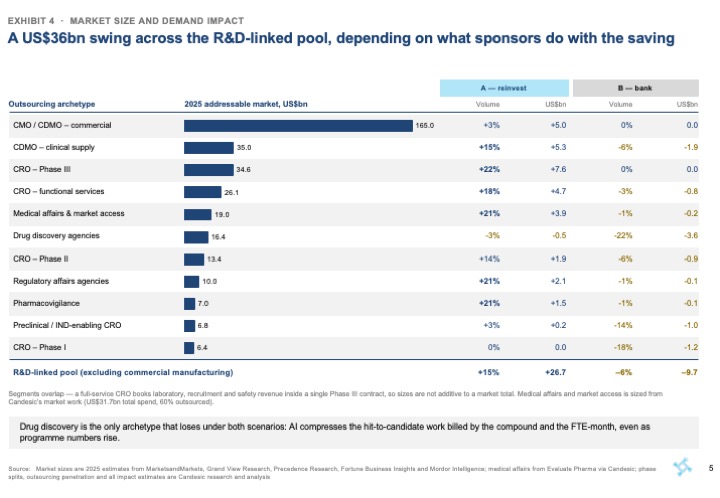
Drug discovery agencies are the main part of the outsourced-services market facing a net headwind. AI compresses the hit-to-candidate work that is billed by the compound and the FTE-month, so more programmes are initiated and each buys less wet-lab time. Preclinical safety carries a second, unrelated pressure from the regulatory shift away from animal testing.
The reinvestment question
The analysis also depends on a factor outside the clinical science – how sponsors respond to higher success rates. Higher success rates effectively give sponsors a productivity gain. The impact on outsourced services will depend on how that gain is used.
If they reinvest – holding Phase I starts constant and taking better odds as more shots on goal – the R&D-linked pool expands by $27 billion. If they retain the savings, targeting the same number of approvals they achieve today, they need only 82% of current Phase I starts. Phase I volume falls 18%, Phase II falls 6%, Phase III is exactly flat, and the pool contracts by $10 billion. Late-phase providers see nothing; discovery, preclinical and early-phase providers lose between a seventh and a quarter of their market.
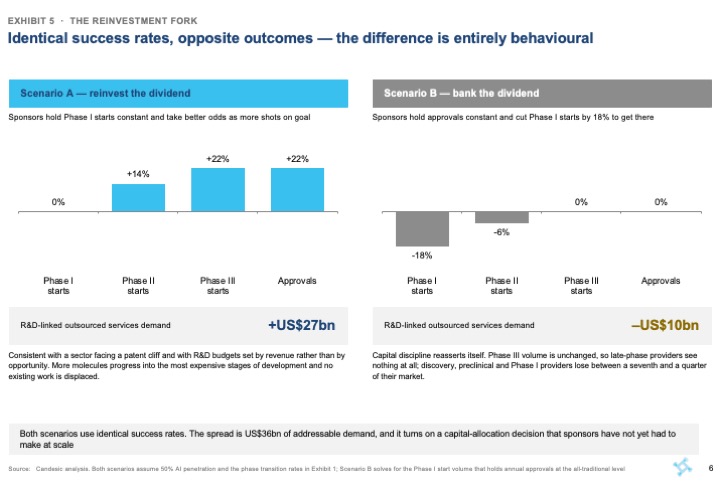
The analysis produces a $36 billion difference between the two scenarios despite using identical clinical assumptions. Candesic’s base case is reinvestment in the near term, because the patent cliff makes pipeline replenishment urgent and R&D budgets are set by revenue rather than by opportunity. This is our base case rather than a certainty, however, and sponsors have not yet had to make this decision at scale – AI-discovered molecules still represent a relatively small proportion of the global development pipeline.
How solid is the evidence?
The evidence base is still relatively small. The published rates rest on 23 clinical-stage assets across eight companies, of which one has produced a controlled efficacy readout and none has read out in Phase III. Wider counts of “173 AI programmes in the clinic” circulate widely but cannot be traced to a published methodology, and Candesic does not rely on them.
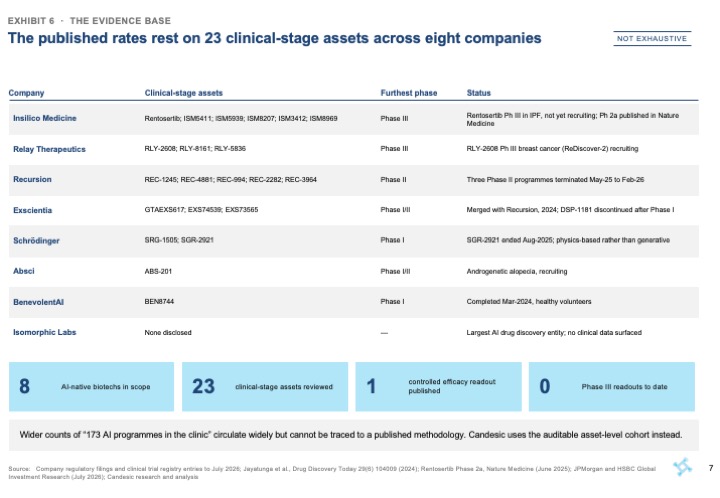
The dataset has real limitations. “AI-discovered” is self-declared and spans everything from molecules generated de novo to candidates a model helped optimise, with no independent adjudication. Success is defined as phase progression, which conflates scientific result with financing decision. And private companies do not publicise quiet failures, so the denominator is almost certainly understated.
Implications for investors
Investors need to focus on later-stage exposure. Phase III execution, functional services, regulatory affairs, pharmacovigilance, medical affairs and commercial manufacturing are the areas most likely to benefit from higher volumes reaching later development stages. Segment disclosure rarely makes late-stage share visible, so this needs diligence.
Drug discovery agencies are the only archetype that loses under both scenarios, and preclinical safety carries an independent regulatory headwind. Investors should be correspondingly cautious about early-stage exposure.
Backlog duration may be more informative than book-to-bill. Compressed timelines convert backlog to revenue faster, flattering near-term growth while shortening visibility, which is an important consideration when assessing CRO valuations. For example, 12% growth supported by 12 months of backlog provides less visibility than the same growth supported by 24 months.
Investors should also consider the impact of AI on trial execution itself, rather than focusing only on discovery and clinical success rates. For example, administrative staff (which account for 11-29% of per-study cost) and site monitoring (a further 9-14%) are precisely the line items AI automates. As volumes rise, prices may fall. That would put pressure on FTE-based contracts, while outcome-based pricing may be better protected.
Investors should make the reinvestment assumption explicit in their forecasts. The upside for CROs turns on sponsor behaviour, not on the clinical science.