Add us as a preferred source

Harm grading is a mandatory part of NHS incident recording, but it has limits. Rebecca Beaumont, Technical Director – Clinical Investigations at Maulin Group, explains what providers need to know.
Harm grading is a key part of NHS England’s Learn from Patient Safety Events (LFPSE) service and a mandatory part of incident recording where a person has been involved. It is important that providers have an awareness of the principles of harm grading and its benefits and limitations within the wider patient safety investigation landscape.
What is harm grading?
The aim of harm grading is to record the actual impact of an incident in healthcare on the patient. NHS England’s policy guidance as part of the LFPSE service is widely used, and built on the principles and standards of the National Reporting and Learning System (NRLS), which LFPSE replaced in 2024.
The harm grades in the LFPSE separate out physical harm from psychological harm, which allows the physical and psychological effects of patient safety incidents to be acknowledged separately. The grades are as follows, shown contrasted again the previous NRLS grades:
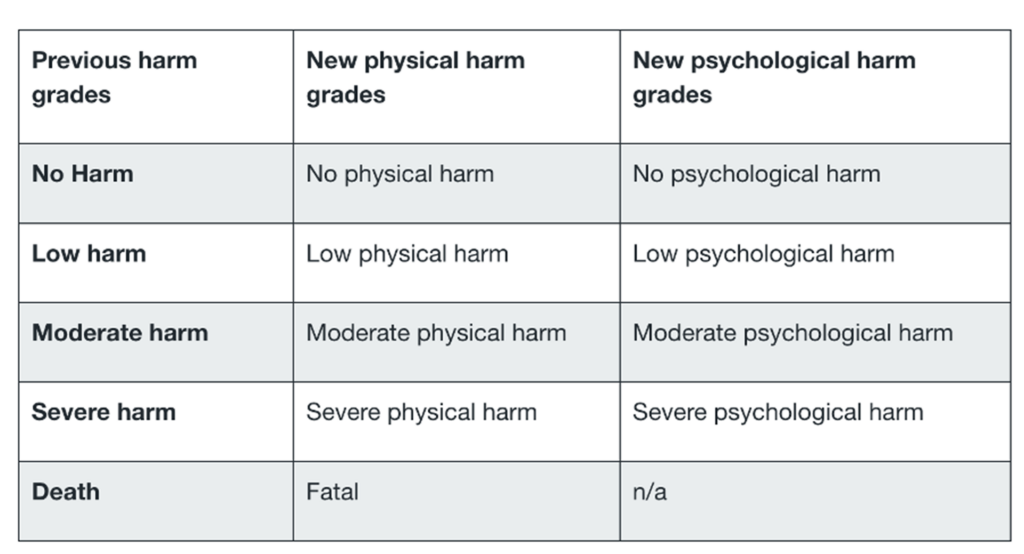
Harm ranges from no harm to severe harm – severe physical harm involving, for example, “permanent harm” or “needing immediate life-saving clinical intervention” and severe psychological harm “distress that did or is likely to result in a new mental health diagnosis, or a significant deterioration in an existing mental health condition, and recovery is not expected within six months.”
The policy guidance outlines that harm grading should be applied based on the best information available at the time of incident recording, and that harm grading can be reviewed and updated as more information becomes available.
What are the benefits and limitations of harm grading in patient safety investigations?
The benefits of harm grading in patient safety investigations are:
- Harm grading incidents allows for the impact on the patient to be recorded. This is strengthened if patients are involved in the investigation process and their views are sought, giving a higher level of confidence that the selected harm grade is reflective of their actual experience.
- Use of a single harm grading matrix, like the LFPSE service’s matrix, ensures that data collected in the aftermath of patient safety incidents and during investigations is consistent. Consistency in data means that comparison is more possible and helps to broaden the conclusions that can be drawn through identification of patterns.
- Harm grading can inform the prioritisation of investigation and patient support and redress. The approach to investigation may need to be different for a patient who has suffered severe harm, as will the support that patient will need. Grading harm can help organisations to use resources effectively and target and tailor support measures for patients.
- Certain levels of harm can constitute notifiable incidents under statutory schemes, such as the Care Quality Commission’s Regulation 20 Duty of Candour. Harm grading allows for other policy, regulatory, and statutory requirements to be enacted promptly and appropriately.
As with any system of categorisation, there are limitations to harm grading such as:
- Variability and inter-rater disagreement can be present. Raters can be presented with exactly the same scenario and assign different harm grades based on their individual interpretation of the categories in the harm scale, personal experience, and background. This was looked at in a 2018 article in Med Care by Walsh et al. They found that reliability improved where 2 reviewers were used as opposed to 1.
- A harm grading can cause anxiety and distress amongst patients if not delivered alongside proper support during a patient safety investigation.
- Harm grading is applied based on the best information known at the time of the incident reporting or patient safety investigation. The patient’s pathway can evolve over time, however, and what started as an incident involving no harm can progress to severe harm if the patient’s condition deteriorates.
- As harm grading can trigger regulatory and statutory duties such as the Duty of Candour, clinicians must feel psychologically safe in assessing incidents and supported to learn from them. Organisational culture can encourage retrospective minimisation of incidents if it is not open, just, and supportive.

What do providers need to be aware of?
Harm grading is a useful tool within the patient safety incident investigation framework, and allows for harm to be categorised, compared, and analysed to allow for providers to systemically learn from incidents.
Providers using harm grading in their incident reporting and requiring the same in independent investigations should ensure:
- Use of multiple reviewers is considered to assist in reducing variability.
- Patients are given a voice during the incident investigation process and supported in understanding and coming to terms with harm.
- Harm grades are revisited to make sure that data is accurate and updated if the patient’s situation changes.
- Staff are regularly trained and supported on the processes surrounding incident reporting and harm grading.
Maulin Investigations have experience of harm grading within patient safety incident investigations and can give robust, independent reviews and advise where policy and procedure can be improved.
For more information on our services, please contact [email protected].