Add us as a preferred source
The latest innovations in healthcare, including Histolog cancer scanning technology, CAR T-cell therapy, a new da Vinci Xi robotic surgery platform, rapid AI scaling across NHS estates and a partnership to launch Men in Mind clinician training.
Nuffield Health Parkside Hospital adopts Histolog scanner for prostate surgery
Nuffield Health Parkside Hospital in London has become the first independent provider in the UK to introduce the Histolog scanner during robotic prostatectomy procedures.
Manufactured by SamanTree Medical, the device uses parallel confocal microscopy to allow surgeons and pathologists to examine excised prostate tissue and assess surgical margins for remaining cancer cells immediately within the operating room.
In conventional pathways, histological margin assessment occurs post-operatively over days. The intraoperative imaging system provides immediate margin feedback while the patient remains on the table. This lets surgeons excise additional cancerous tissue if required while preserving delicate surrounding nerves to reduce risks of post-operative incontinence and erectile dysfunction.
The first three Histolog-assisted procedures at Parkside Hospital were completed by consultant urological surgeon Wissam Abou-Chedid, supported by consultant histopathologists Ben Haagsma and Poonam Pingle.
“This technology allows us to assess the prostate specimen and surgical margins during the operation rapidly, providing valuable real-time information that can guide our surgical decisions,” said Abou-Chedid. “By combining advanced intraoperative margin assessment with a precise, nerve-preserving robotic approach, our aim is to maximise cancer control while minimising the risk of complications.”
HCA Healthcare UK expands CAR T-cell therapy access
HCA Healthcare UK has expanded its provision of Chimeric Antigen Receptor (CAR) T-cell therapy to eligible blood cancer patients at The Christie Private Care in Manchester. The rollout makes the site the only independent healthcare provider outside of London to offer the specialised cellular immunotherapy.
HCA UK has offered CAR T-cell therapy for lymphoma and leukaemia patients in London since 2019, extending provision to multiple myeloma last year. The expansion to Manchester covers adult patients with relapsed or refractory blood cancers, including diffuse large B-cell lymphoma (DLBCL), follicular lymphoma (FL), mantle cell lymphoma (MCL), high-grade B-cell lymphoma (HGBL), primary mediastinal large B-cell lymphoma (PMBCL), multiple myeloma (MM), and B-cell acute lymphoblastic leukaemia (B-ALL).
The multi-step personalised treatment involves harvesting a patient’s T-cells via leukapheresis, genetically engineering them in a laboratory to express targeted chimeric antigen receptors, multiplying the modified cells, and reinfusing them to locate and destroy cancer cells.
“As the only independent provider outside of London currently offering this highly specialised therapy, this milestone reflects our ongoing commitment to delivering world-class cancer care,” said Jane Whitney-Smith, chief executive of The Christie Private Care.
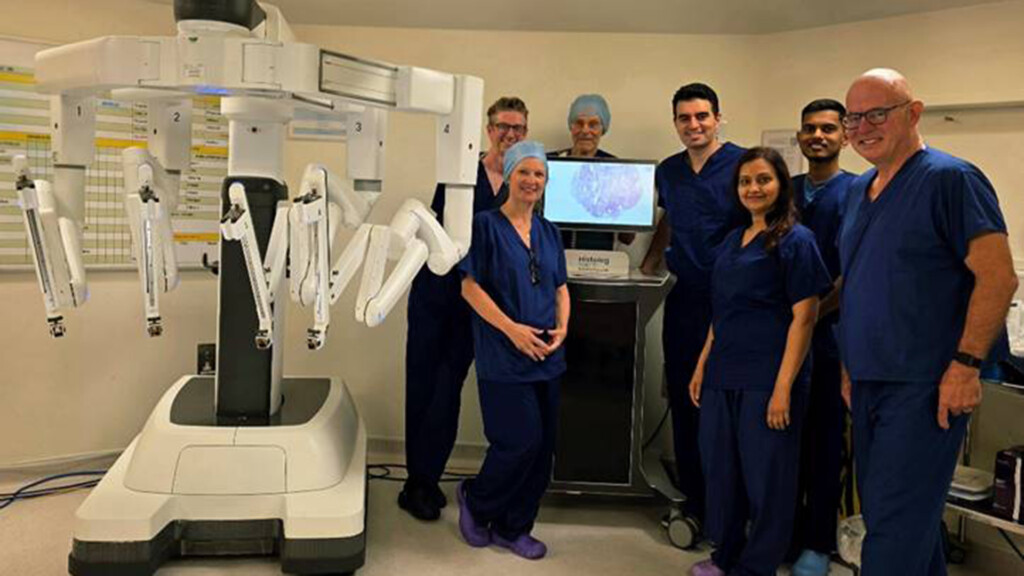
Nuffield Health treats first patients with da Vinci Xi surgical robot
Nuffield Health’s The Manor Hospital in Oxford has introduced the da Vinci Xi robotic-assisted surgical system, expanding its capacity for complex, minimally invasive procedures across Oxfordshire.
The fourth-generation multi-port platform developed by Intuitive has been deployed for complex urological and colorectal surgeries – including prostate, kidney, and colorectal procedures – with gynaecological applications set to follow.
The da Vinci Xi platform features a console where the surgeon operates wristed instruments with full three-dimensional, high-definition visualisation and tremor-filtration technology. The system’s boom-mounted architecture translates manual hand movements into micro-movements inside the patient, providing a greater range of motion than human hands while requiring fewer and smaller incisions compared to traditional open surgery.
The introduction of the robotic system is intended to reduce length of stay, post-operative complications and blood transfusion requirements for surgical patients. The deployment complements wider clinical technology investments at The Manor Hospital, including a recently opened diagnostic imaging hub featuring AI-enabled scanners from GE HealthCare.
“The da Vinci Xi Surgical System allows us to perform complex prostate and kidney procedures with exceptional precision through a minimally invasive approach,” said Tom Leslie, consultant urological surgeon at Nuffield Health The Manor Hospital. “For patients, this can mean less pain, a shorter hospital stay and a faster return to normal activities.”
GenesisCare and CUH launch private advanced cell therapy pathway
Independent cancer care provider GenesisCare has partnered with Cambridge University Hospitals NHS Foundation Trust (CUH) to launch a dedicated private patient pathway for advanced cellular immunotherapies, supported by a mobilisation fund provided by GenesisCare.
The collaboration brings private access to cell therapies – such as CAR-T therapy and autologous stem cell transplantation (ASCT) – across a national network of outpatient cancer centres outside London.
Under the model, CUH will deliver complex inpatient procedures at Addenbrooke’s Hospital, while GenesisCare’s national outpatient centre network will manage pre- and post-treatment care within an ambulatory pathway model. The pathway is designed for patients with complex haematological conditions, including myeloma and lymphoma, to streamline access to newly licensed cell therapies while reducing hospital stay durations.
The service is led by Karthik Ramasamy and supported by a national consortium of haematologists and a dedicated cell therapy multidisciplinary team. Each patient will be supported by a clinical nurse specialist acting as a single point of contact throughout the treatment journey.
“Our aim is to ensure that patients with complex haematological diseases receive access to the very latest cellular therapies, delivered by a national team of experts dedicated to providing the highest standards of care,” said Karthik Ramasamy, lead specialist for the service.

CompliMind expands across UK healthcare estates
Cambridge compliance intelligence startup CompliMind has expanded from a single NHS pilot to 18 live deployments across healthcare organisations and private providers within 18 months. The platform currently supports 15 NHS trusts across England, Wales and Northern Ireland, including Somerset NHS Foundation Trust, University Hospital Southampton Estates Limited, Cambridge University Hospitals, Liverpool University Hospitals, Swansea Bay University Health Board and Belfast Health and Social Care Trust.
Founded by Cambridge researchers Carl-Magnus von Behr and Jan Blümel, CompliMind provides a specialised AI compliance platform tailored for estates and facilities teams managing safety-critical hospital infrastructure. The software consolidates regulatory documentation, Health Technical Memoranda (HTMs), and local policies into a unified, real-time interface. Every query generates an evidence-backed response with direct source citations and a complete audit trail, enabling staff to verify regulatory information before making operational decisions.
The technology has demonstrated notable operational savings across initial deployments. At Somerset NHS Foundation Trust, the platform reduced the time spent searching for compliance documentation by up to 35%, freeing over 400 staff hours per month. Additionally, at University Hospital Southampton Estates Limited, CompliMind surfaced an unrecorded contract anomaly that recovered £45,000 in annual savings, while at Neath Port Talbot Hospital, the platform reviewed more than 6,000 building condition images to replace an estimated 1,000 hours of manual assessment.
“Estates teams responsible for hospitals are being asked to prove compliance across more regulation, with fewer people to do it,” said von Behr, co-founder and chief executive of CompliMind. “They need answers built on evidence they can verify and trace back to source. CompliMind was built to give estates professionals that confidence.”
Secure I.T. Environments upgrades for NHS Foundation Trust
Data centre design and build firm Secure I.T. Environments Ltd (SITE) has completed live UPS and cooling infrastructure upgrades across two data centre facilities for an unnamed NHS Foundation Trust in South East England. The dual-site project modernised the Trust’s core digital infrastructure to enhance resilience, increase power scalability and lower energy expenditure.
At the primary site, SITE replaced end-of-life power systems with a modular Riello Multi Power UPS platform. The installation includes two Riello MPW 252kVA chassis, each initially configured at 84kVA N+1 using 42kW power modules. The modular architecture allows the Trust to incrementally scale power capacity as digital demands grow without replacing the core platform. The migration was executed across two planned weekend shutdowns, replacing streams individually to maintain uninterrupted power.
At the second site – a data centre supporting an 800-bed hospital – SITE decommissioned ageing air handling units (AHUs) and built a new ground-level condenser compound to replace the previous underground facility. The new installation features energy-efficient FläktGroup AHUs engineered to withstand projected heatwave conditions while providing automated network monitoring. The upgraded cooling infrastructure is projected to reduce carbon emissions by over 58,000 kg annually and generate £32,305 in annual energy savings, achieving full return on investment in just over three years.
“In hospital environments, the resilience of supporting infrastructure has to be treated with the same discipline as the IT systems it protects,” said Jo-Anne Garvie, commercial director at Secure I.T. Environments. “These projects have resulted in a more flexible and maintainable power platform and energy-efficient cooling infrastructure. Together, they support the Trust’s current operational needs and give it a clear path for future expansion.”
RLDatix launches AI-driven shift matching platform
Healthcare workforce management and patient safety software provider RLDatix has rolled out Smart Match, an artificial intelligence platform designed to optimise clinical staff rostering across health and care organisations. The tool is currently being deployed to more than 200 UK healthcare organisations following pilot trials within NHS trusts.
Smart Match automates duty fulfilment for internal bank workers across nursing, medical and non-clinical staff groups. Instead of broadcasting unassigned shifts to entire worker pools, the platform uses predictive AI algorithms to analyse individual booking histories, availability and past behaviours to deliver personalised and targeted shift notifications for urgent and routine bank duties directly to the workers.
Pilot evaluations conducted across healthcare organisations – including The Shrewsbury and Telford Hospital NHS Trust – showed operational improvements. Bank-filled duties increased by up to 20%, while overall bank worker deployment rose by up to 17% alongside a 26% increase in direct worker self-booking. The automated system also reduced the administrative burden on out-of-hours teams by decreasing reliance on manual email broadcasts and phone calls to cover short-notice shifts.
“We have already seen very encouraging results from Smart Match in our pilot customers, results that demonstrate a material financial and staff satisfaction impact to the NHS,” said Barbara Staruk, chief product officer at RLDatix. “Smart Match is now being rolled out to more than 200 UK customers. This is just the start of our AI journey, and we look forward to bringing even more AI-driven value across our workforce management, safety, and compliance platforms in the weeks and months to come.”
Bupa to roll out Men in Mind clinician training
Global healthcare company Bupa has partnered with men’s health charity Movember to roll out the Men in Mind training programme to clinicians across its Mindplace mental health centres in the UK and Australia.
The initiative responds to research indicating that 45% of men disengage from mental health therapy before completing treatment, despite high rates of prior healthcare contact among men who experience mental health crises.
Developed by clinical psychologist Zac Seidler, global director of Men’s Health Research at Movember, Men in Mind equips mental health practitioners with evidence-based strategies to tailor therapeutic approaches, better recognise male-specific expressions of distress, and improve retention among male patients. The training will be delivered virtually through Bupa Campus, Bupa’s global learning platform, to clinicians across the Mindplace network.
The collaboration is part of Bupa’s £140 million investment into Mindplace, its network of walk-in and appointment-based mental health centres, with plans to open 200 sites globally by 2028. Demand for mental health support among men continues to accelerate, with Bupa reporting a 280% increase in male customers accessing its mental health services since early 2025, while men currently account for 50% of customers accessing Mindplace sites since launch.
“Mental health is one of the defining healthcare challenges of our time, and better outcomes depend not only on expanding access to support, but ensuring people remain engaged once they seek help,” said Melvin Samsom, chief medical and sustainability officer at Bupa Group. “This training helps scale research-backed approaches that support earlier intervention, improve engagement and ultimately ensure more people receive the care they need before reaching crisis point.”