 Add us as a preferred source
Healthcare organisations continue to invest in digital systems to support care delivery, operational efficiency and financial management. Electronic patient records, procurement platforms and billing solutions now play a central role across hospitals.
However, despite this progress, a familiar challenge remains.
While individual systems are effective within their own functions, they often still operate independently of one another, resulting in siloed working. Data exists across multiple platforms, often captured at different times and in different ways, making it difficult to build a clear and consistent view of activity.
This is increasingly important across the NHS. Bringing together clinical, operational and financial information through better visibility is no longer simply a digital ambition, it is becoming critical to improving efficiency, supporting staff and delivering better patient outcomes.
Healthcare is not simply a software problem to solve. It is a human system that depends on people, processes and information working together effectively. The role of technology is not just to digitise activity, but to support connected workflows that reduce duplication, improve visibility and help staff focus more time on patient care.
The challenge of fragmented data
For a single patient pathway, data is often recorded across different systems at different stages of care.
Information captured during care may later need to be re-entered for operational or financial purposes. Over time, this can lead to fragmentation, with data spread across systems rather than forming a single, continuous dataset.
This can make it more difficult to access accurate information when needed, clearly link care activity to financial reporting, and maintain consistency across departments.
Moving towards a more connected model
Healthcare organisations are looking to improve visibility across clinical, operational and financial workflows.
One approach gaining attention is capturing information at the point of care and enabling it to be used across multiple systems without the need for re-entry.
Rather than replacing existing systems, a connected approach helps organisations make better use of the technology already in place. By creating a shared patient-level dataset, teams can improve visibility, strengthen alignment between departments and access more consistent information.
Enabling connected workflows with h-trak
As Trusts look for practical ways to reduce fragmentation, administrative burden, and support best practice, h-trak is already in use across multiple NHS organisations.
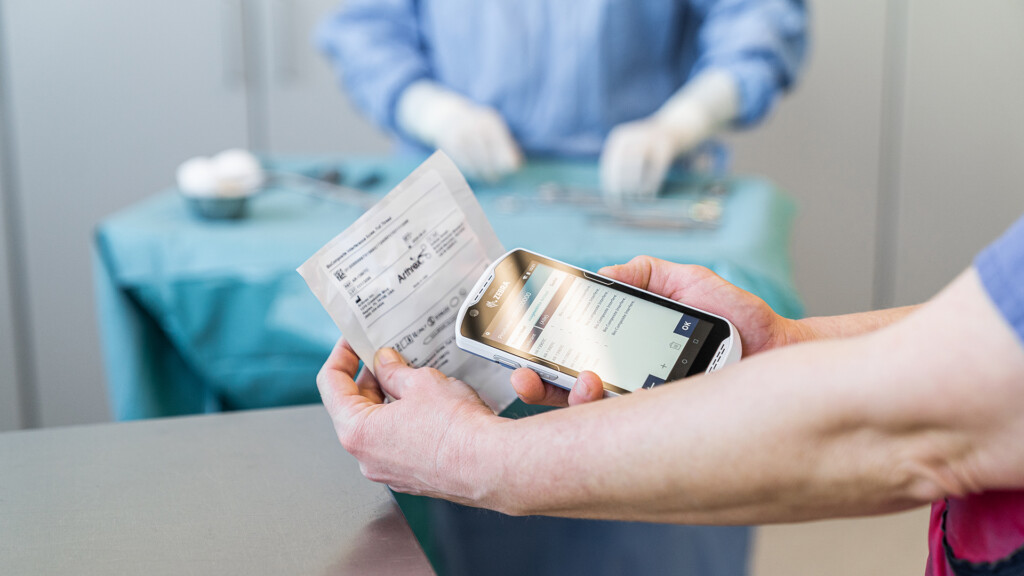
Using handheld scanning technology, staff can record patient identification before capturing the consumables, implants and instruments used during a procedure. Creating a real-time record of what was used, when, by whom and for which patient.
- Because the data is structured as it is captured, it can support multiple workflows without duplicate entry, including:
- Clinical documentation
- Inventory management and stock reordering
- Financial reporting and procedure-level costing
- Product traceability and recall management
- Procurement planning through more accurate usage visibility
By linking usage directly to individual procedures, organisations can gain visibility of procedure-level costs, identify clinical variation or potential wastage, and respond more effectively to product recalls or field safety notices through the capture of detailed product information, including lot and serial numbers.
At the same time, reducing manual processes helps release staff time back to patient care while creating a consistent dataset that supports benchmarking and best practice.
h-trak is designed to work alongside existing systems, helping organisations connect workflows through a single, consistent source of data.
Delivering results in practice – Case study
This approach is in use at University Hospitals of Derby and Burton NHS Foundation Trust (UHDB).
Working with h-trak, the trust introduced point-of-care data capture across 68 operating rooms and procedure areas. Staff now record patient details alongside consumables, instruments, trays and implants during procedures, creating a direct link between care delivery and material usage. To date, nearly 500,000 procedures have been captured and costed through the system.
As James Mayne, Head of Programme Management at UHDB, explains: “Before introducing h-trak, we faced significant challenges managing multiple stock systems and keeping track of patient-level costs. Processes were fragmented and time-consuming, and manual tracing of items during procedures made it difficult to ensure accuracy and efficiency.
The implementation of real-time point-of-care data capture has truly transformed our operations. We now have immediate visibility over stock usage and costs, which has strengthened our ability to control inventory and make more informed financial decisions. The patient traceability for implants, consumables, trays and instruments is also key in terms of data capture whilst ensuring it’s efficient for staff to capture accurately and data maintained.
One of the greatest benefits has been the improvement in collaboration between procurement, finance, and clinical teams. With consistent, real-time data accessible to everyone, we’re able to align our priorities, share insights, and work together more effectively than ever before. This shared visibility has led to stronger teamwork and has supported efforts to reduce waste and optimise resource allocation and work towards procedure packs and product standardisation.
Administrative burden has also decreased substantially. Tasks that once required manual input and cross-checking are now streamlined, freeing up valuable time for staff. Traceability has improved, giving us confidence in our records and supporting patient safety.
Having consistent patient-level data is crucial, as it provides a reliable foundation for cost analysis, benchmarking, and decision-making. It empowers us to deliver high-quality care while managing resources responsibly, and it has been instrumental in driving positive change across the trust.”
A practical step forward
Reducing siloed working is not about replacing existing systems but improving how they work together.
By capturing information once, at the point of care, organisations can reduce duplication while improving visibility across clinical, operational and financial workflows.
Technology delivers the greatest value when it supports staff in the background, helping reduce administrative burden and enabling more time to focus on safe, effective patient care.
If you’re looking at ways to improve visibility, while reducing reliance on fragmented systems and manual processes, this approach could help support more connected ways of working across your organisation.
To find out more about how h-trak is being used in practice, you can get in touch with the team.
+44 (0)330 127 6240
[email protected]