Add us as a preferred source
The latest innovations in healthcare, including numerous new partnerships, photonic eye imaging for children and sleep apnoea implant procedures.
The London Clinic partners with Grosvenor Orthopaedic Partners
Independent charitable hospital The London Clinic has partnered with specialist group Grosvenor Orthopaedic Partners to bring 25 orthopaedic surgeons and musculoskeletal consultants into its clinical network.
Under the agreement, Grosvenor Orthopaedic Partners will establish a dedicated outpatient presence at The London Clinic’s 20 Devonshire Place facility following a refurbishment of the site. The newly upgraded facility features ten consulting rooms and a dedicated treatment area, integrating the group’s consultant leadership across sub-specialities – including hip, knee, shoulder, elbow, hand and wrist, spine, foot and ankle, sports injuries, trauma, paediatrics and sarcoma care – with the hospital’s multidisciplinary teams and operational infrastructure.
“By working together, we have an exciting opportunity to further develop specialist orthopaedic services, share expertise and ensure patients benefit from the highest standards of treatment, rehabilitation and recovery,” said Mark Webb, chief commercial officer at Grosvenor Orthopaedic Partners.

The National Longevity Clinic launches in Harley Street and Richmond
The National Longevity Clinic has opened two London locations in Harley Street and Richmond focused on healthy ageing and early intervention.
Co-founded by cardiologist Francesco Lo Monaco and Audrey Ottaviani-Lo Monaco, the clinic combines conventional clinical diagnostics with functional medicine, nutrition, sleep management, stress reduction and mental health support. Rather than treating isolated symptoms, the multidisciplinary facility evaluates overall biological health to map individual risks and establish personalised preventive care plans.
The clinic’s team spans specialists across cardiology, women’s health and fertility, urology, functional medicine, clinical exercise physiology, functional psychiatry and neuro-acoustic therapy.
“Our aim is to combine conventional diagnostics with functional medicine, nutrition, sleep, stress management and mental-health support to build a clearer picture of each individual,” said Audrey Ottaviani-Lo Monaco. “By bringing different specialists together, we can look beyond isolated symptoms and develop personalised plans that support the whole person.”
bit.bio partners with myriamed to expand drug discovery portfolio
Synthetic biology firm bit.bio has signed an exclusive partnership with German biotechnology company myriamed to integrate human iPSC-derived cardiomyocytes into its cell product portfolio.
The collaboration expands Cambridge-based bit.bio’s research offerings into cardiovascular disease modelling and early-stage cardiotoxicity screening.
Through the agreement, bit.bio will exclusively supply myriamed’s cryopreserved, off-the-shelf ventricular and atrial cardiomyocytes, alongside specialised disease models for dilated cardiomyopathy and real-time reporter cells designed for high-throughput phenotypic screening. The cell line models will also be integrated into bit.bio’s functional CRISPR screening service workflows. All cells in the suite share a single donor background, providing a genetically matched, human-relevant system suitable for comparative atrial and ventricular studies as well as 3D tissue engineering applications.
By supplying ready-to-plate human cardiomyocytes, the companies aim to reduce reliance on animal testing in line with global regulatory frameworks such as the US FDA Modernization Act 2.0.
“By bringing myriamed’s cardiomyocytes into bit.bio’s portfolio, we’re providing researchers with the cells they need to model cardiomyopathy, and use across applications ranging from 2D screening to 3D models, or run a safety screen, all in the same physiologically-relevant background,” said bit.bio chief executive Emma Pepperell. “Partnerships such as this can help accelerate the pharmaceutical industry’s shift towards more predictive, human-relevant approaches to drug development.”
Simplyhealth and Personal Group expand partnership
Healthcare services provider Simplyhealth has expanded its strategic partnership with employee benefits and insurance business Personal Group.
The extended agreement embeds Simplyhealth’s On Demand services into Hapi, Personal Group’s employee benefits platform. Through the integration, covered employees gain access to self-pay and discounted clinical and wellbeing support, including virtual physiotherapy, mental health consultations, men’s and women’s health pathways, nutritional guidance, diagnostic testing and neurodiversity assessments. Reciprocally, Simplyhealth will offer the Hapi platform to its corporate client network, expanding distribution of Personal Group’s employee engagement and financial protection tools.
The expansion builds upon the initial strategic partnership launched between the two organisations in March, which aligned Simplyhealth’s health cash plans with Personal Group’s insurance products.
“People are more likely to engage with support when it’s easy to find, easy to access and integrated into their everyday experience,” said Paul Schreier, chief executive officer of Simplyhealth. “By bringing our services to Hapi, we have the opportunity to reach over one million additional people, helping more employees access the support they need.”

UCL Great Ormond Street Institute of Child Health partners with Siloton
Researchers at the UCL Great Ormond Street Institute of Child Health are collaborating with Bristol-based healthtech startup Siloton to adapt a photonic chip-based optical coherence tomography (OCT) system for paediatric eye care.
Funded by the National Institute for Health and Care Research (NIHR), the project aims to modify Siloton’s compact OCT technology for use in community settings and home monitoring to prevent childhood sight loss.
Standard OCT systems use light to generate high-resolution cross-sectional images of the retina, but their large physical footprint and high costs restrict their use to secondary care hospitals and optometry clinics. Siloton’s Akepa technology condenses tabletop-style optical components onto a single photonic chip smaller than a £1 coin and housed within a portable, binocular-style device.
The UCL team will adapt the system’s hardware and optics for paediatric use. Modifications include recalibrating the internal lenses for children’s eyes and reshaping the facial casing to eliminate ambient light interference during home-based scans. The adapted device is intended to assist in monitoring pediatric conditions – including inherited retinal diseases, diabetes-related ocular issues and optic disc swelling associated with intracranial pressures – without frequent hospital visits.
“Imaging children’s eyes presents different challenges, but the chip-based system we’ve developed could make it easier to capture high-quality images quickly and comfortably,” said Siloton chief executive Alasdair Price. “By making it possible to image outside a hospital environment, our system could reduce disruption for families and free up clinicians to spend more time on care.”
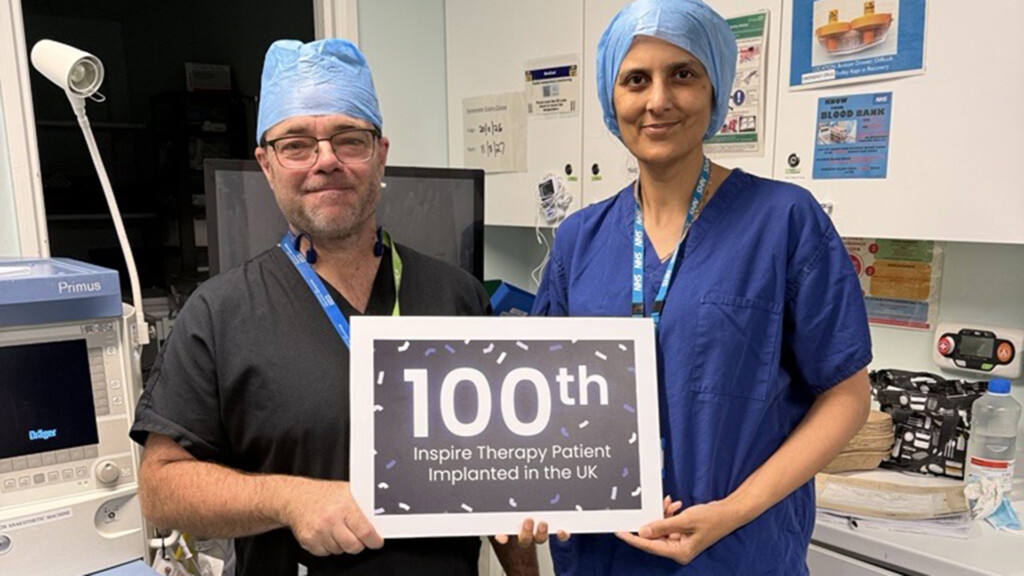
Inspire therapy implant reaches 100th UK procedure
A modern, pacemaker-style surgical implant for obstructive sleep apnoea (OSA) has reached its 100th UK procedure, marked by an operation at Trafford General Hospital, part of Manchester University NHS Foundation Trust.
Developed by Inspire Medical Systems, the device provides an alternative treatment path for patients with moderate-to-severe OSA who are unable to tolerate standard Continuous Positive Airway Pressure (CPAP) therapy. The upper-airway stimulation system is surgically implanted beneath the skin. It works in synchronisation with the patient’s natural breathing cycle to deliver mild stimulation to the hypoglossal nerve, maintaining tongue position and preventing airway collapse without requiring facial masks or bedside machinery. Patients activate the device using a handheld remote before sleeping.
“Reaching 100 patients is an important milestone and highlights the growing number of people being supported through alternative care pathways. It marks not just a number, but a collective effort from patients, clinicians, and UK healthcare systems working together to expand options in sleep health,” said Ed Holyoak, regional director of the UK and Nordics, Inspire Medical Systems.

Northern Ballet and Leeds Hospitals Charity launch VR dance initiative
Northern Ballet and Leeds Hospitals Charity have launched a virtual reality pilot project to explore how immersive dance and natural soundscapes can alleviate stress, pain and isolation for young hospital patients.
The pilot will see hospital Play Specialists at Leeds Children’s Hospital use 360-degree VR headsets with patients aged eight to 16 who are bed-bound or undergoing long hospital stays. The five-minute immersive experience transports patients out of clinical wards and into Otley Chevin Forest Park in Leeds to watch a dance piece performed by Cameron Pugh of the Northern School of Contemporary Dance and choreographed by Northern Ballet’s George Liang. The visual performance is paired with an original score composed by Leeds Conservatoire.
Academic partners, including the University of Leeds and Leeds Beckett University through the Child Health Outcomes Research at Leeds programme, will evaluate patient feedback captured during the autumn trial. The project is funded by The Linbury Trust and forms part of the Seasons of Culture 2026 initiative led by Leeds City Council and the West Yorkshire Combined Authority.
“We know that dance can transport audiences to a different time and place… but to be able to do this in a fully immersive way takes this to a whole new level,” said Federico Bonelli, artistic director at Northern Ballet. “I hope the powerful combination of nature, beautiful movement from the dancer and the immersive soundscape will help children feel calmer and less isolated in hospital.”
Martin House hosts inaugural children’s palliative care conference
Martin House Children’s Hospice welcomed more than 70 healthcare professionals to its Boston Spa facility for its inaugural paediatric palliative care conference, Inspiring Excellence.
Held at the charity’s newly redeveloped site, the event brought together clinicians, practice educators and community health teams to share specialist knowledge and evaluate practical approaches to supporting children with life-shortening conditions. The programme covered community-based palliative care, real-life case studies, current research initiatives and practical afternoon workshops focusing on post-death care simulation training and referral pathways.
“Children’s palliative care is about helping babies, children and young people live as fully and comfortably as possible, while supporting their whole family,” said Charlotte Walker, deputy director of clinical services at Martin House. “Children with life-shortening conditions may receive care in many different places, not only in a hospice. By sharing the expertise developed at Martin House, we can help more professionals feel confident supporting children and families wherever they encounter them.”