Add us as a preferred source
The latest innovations in healthcare, including international telehealth expansion, AI-driven risk intelligence collaboration, liver fibrosis, wearable clinical documentation devices, localised contextual artificial intelligence pilots for care navigation, data exploration, rebranding, neurodiversity, workflow fragmentation and digital exercise.
Marsh inks exclusive UK healthcare risk collaboration with Kirontech
Insurance broker and risk adviser Marsh is to collaborate with Cambridge-based healthtech innovator Kirontech. The collaboration is designed to combine Kirontech’s AI-enabled claims risk intelligence platform with Marsh’s clinical governance and healthcare consulting framework.
Under the terms of the agreement, Marsh clients across corporate health trusts, private medical insurance (PMI) claims environments, and NHS-commissioned care settings will be given direct access to retrospective audits of their historical medical treatment data.
The software analyses historical provider invoicing, billing codes and insurer-approved treatment plans. By cross-referencing this data, the system builds a clearer picture of payment integrity, enabling corporate benefits teams and hospital leadership to identify overpayments, uncover systemic administrative waste and maximise clinical resources.
Ultimately, the insights are designed to help organisations refine their corporate health strategies, improve clinical governance and reduce instances of avoidable patient harm through data-driven risk management.
“Healthcare organisations are sitting on data that could transform how they manage risk and allocate resources, but turning that into confident, board-level decisions requires the right expertise alongside the right technology,” said Omar Chebli, chief executive officer of Kirontech.

Doctify expands global footprint with Saudi Arabia launch
Global patient feedback platform Doctify is to expand into Saudi Arabia, entering a rapidly evolving healthcare market where patient choice, private enterprise and transparency are becoming central to clinical access.
The move builds on the company’s existing operations across the UK, Ireland, Germany, Austria, the UAE and Australia.
The launch arrives as the Gulf nation transforms its healthcare ecosystem into a more digital, privatised, and consumer-driven landscape. Driven by the Kingdom’s Vision 2030 Health Sector Transformation Program, the expansion comes at a time when the private sector is taking on a significantly larger role in care delivery. Backed by a $57 billion (£42.6 billion) health budget and a 98% smartphone penetration rate, the market is digitising at pace. As insurance-led healthcare options expand, providers are increasingly forced to differentiate themselves based on verified patient experience and corporate reputation, particularly as the country aims to attract over one million medical tourists by 2030.
The platform addresses this market transition by allowing patients to search for providers by speciality and location, read verified peer-to-peer endorsements, and book appointments or digital consultations. For clinicians and hospitals, it provides structured, real-time feedback to mitigate administrative burdens and drive continuous service improvements.
“Saudi Arabia is undergoing a significant transformation in how healthcare is delivered and experienced,” said Stephanie Eltz, chief executive and co-founder of Doctify. “Launching in Saudi Arabia allows us to contribute to a healthcare system that is becoming more connected, more transparent, and more patient-centred.”
Engitix and GSK target liver fibrosis regression
London-based biotechnology company Engitix has announced a research collaboration and option agreement with GSK.
The multi-year alliance hopes to identify and validate novel therapeutic targets capable of driving liver fibrosis regression, addressing a critical historical gap in drug discovery that has traditionally focused on halting disease progression rather than actively reversing tissue damage.
The joint venture will use Engitix’s human extracellular matrix (ECM) platform alongside its deeply phenotyped translational multi-omics datasets. By combining these human-centric disease models with GSK’s commercial drug development infrastructure, the partners aim to discover high-confidence, functionally validated targets grounded directly in human disease biology.
Under the terms of the agreement, Engitix is eligible to receive up to £44.5 million in upfront and near-term payments, up to £118 million per target in downstream milestone payments, and low-single-digit royalties on future commercial product sales.
As part of the operational framework, Engitix will handle the development of the human ECM-based models and generate high-resolution datasets mapping fibrosis resolution in liver disease, while GSK maintains the option to license any resulting assays, datasets, and targets. “By combining our human-centric disease models with GSK’s development capabilities, we aim to identify and validate high-confidence targets with the potential to transform treatment for liver fibrosis,” said Giuseppe Mazza, co-founder and chief executive of Engitix.
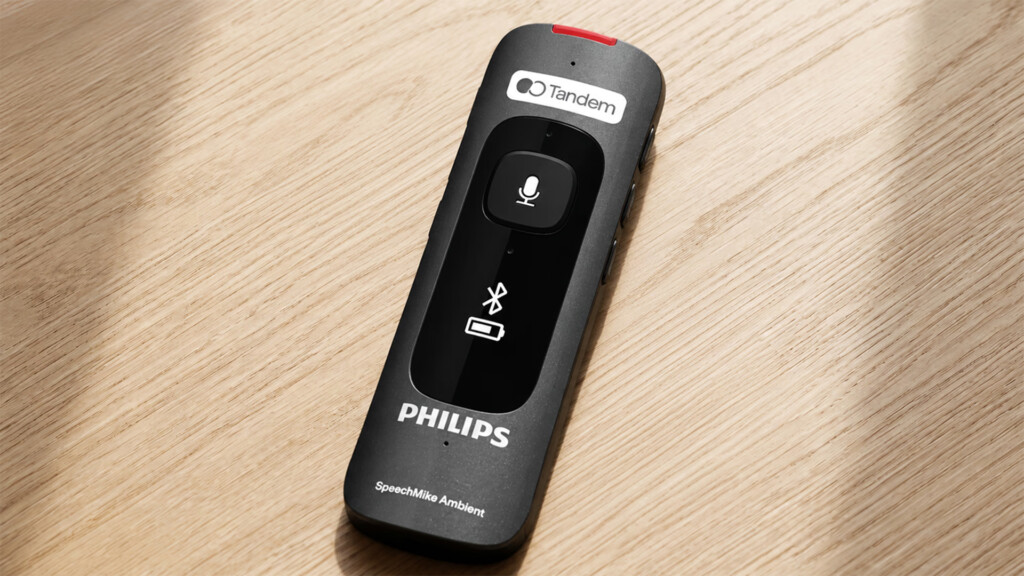
Tandem Health partners with Philips Dictation
European ambient AI platform Tandem Health is to partner with Speech Processing Solutions (SPS) – the organisation behind the Philips Dictation portfolio. The collaboration marks the launch of enterprise-grade ambient AI documentation software designed specifically for healthcare organisations.
The partnership combines the newly developed Philips SpeechMike Wearable AI Assistant with Tandem Health’s AI clinical documentation platform. The Philips SpeechMike is a professional-grade wearable microphone engineered for high-fidelity, clinical-grade speech capture across noisy clinical environments. This hardware creates an end-to-end workflow that feeds high-fidelity audio directly into Tandem’s AI Scribe, capturing medical consultations clearly and translating them immediately into highly structured clinical notes.
The purpose-built wearable is designed to be worn by clinicians throughout their shift, allowing large-scale healthcare networks to deploy ambient AI technologies without compromising clinical accuracy or user experience.
“When I qualified, the stethoscope defined what it meant to be equipped for practice,” said Katie Baker, country director for UK & Ireland at Tandem Health. “As ambient AI becomes embedded in clinical care, the wearable microphone is emerging as its natural pairing.”
OneAdvanced partners with NVIDIA for NHS care navigation
SaaS provider OneAdvanced has completed a pilot programme with NVIDIA to develop a contextual, sovereign-AI model for NHS Care Navigation.
Trained on pseudonymised real-world patient online consultation requests, the pilot demonstrates that the Care Navigator LLM can materially improve triage accuracy, support faster access to appropriate care and reduce resource wastage across the health service.
Importantly, all patient data processed through the model is stored, hosted and governed under UK law – keeping model weights, fine-tuning, hosting and inference completely within the UK perimeter to meet data residency and regulatory compliance standards.
The pilot used NVIDIA Nemotron open models and NeMo libraries, training the AI on a stratified, balanced dataset extracted from OneAdvanced’s established triage and online consultation platform, Patchs, which currently manages over 500,000 monthly UK patient interactions. The Care Navigator LLM was benchmarked against other public frontier models, including Claude Sonnet and Claude Opus. The results showed that OneAdvanced’s specialised model delivered up to 150 times lower inference costs than those frontier alternatives, while simultaneously outperforming Claude Sonnet and Haiku variants and achieving significantly higher accuracy than a GP control group in benchmark categorisation tasks.
Unlike generic, public LLMs, the system is designed to learn directly from clinical oversight in the live flow of work, meaning corrections made by practising GPs form the basis of its continuous training data.
“Detecting clinical topics in patient requests is key to enable the AI Care Navigator to ask the right follow-up questions and provide the right response to patients,” said Ben Brown, medical director at OneAdvanced.
MFT to leverage MDClone ADAMS platform
Manchester University NHS Foundation Trust (MFT) will launch the Ask, Discover, Act, Measure and Share (ADAMS) platform, developed by healthtech provider MDClone, in July.
The initiative is designed to grant clinicians and approved internal teams more autonomous access to datasets to drive system-wide improvements in clinical quality, productivity and hospital performance. By streamlining data exploration, the platform aims to reduce the time it takes for healthcare professionals to move from an initial clinical question to actionable insights.
A feature of the new platform is its privacy-enhancing capability, which generates high-fidelity synthetic data. This allows researchers and approved academic or industry partners to test ideas, conduct clinical audits and build patient cohorts without needing to access real patient files in many scenarios. To maintain strict security, the platform operates entirely within MFT’s existing network environment and governance framework, ensuring that all data remains under direct NHS control and is limited exclusively to authorised users.
The software also features AI-assisted analysis, enabling users to query complex medical data using plain English. When the system goes live, MFT intends to focus its initial efforts on tracking and improving pathways for kidney disease.
“The real benefit of this platform is that it allows healthcare professionals to go from an idea to an answer in a matter of minutes,” said Anthony Wilson, group chief medical informatics officer for research and innovation at MFT.

Health data platform Medi2data rebrands to Lalu
AI-enabled health data platform Medi2data has rebranded as Lalu to meet what it calls a growing cross-sector demand for consented, curated health data.
Founded in 2017, the company is an NHS-accredited data partner designed to solve the complexities of retrieving medical files from fragmented and outdated legacy infrastructure. By converting unstructured, disparate medical records into streamlined data outputs, the platform enables healthcare providers, commercial businesses and individual citizens to access vital information more efficiently. This means a reduction in processing turnaround times and supports better-informed decision-making.
The rebrand consolidates Lalu’s core services into a unified, scalable ecosystem featuring three dedicated service portals. These include Lalu Care, which provides smart data solutions for healthcare professionals; Lalu Hub, designed to assist businesses with secure data retrieval; and Lalu Me, an expanding consumer-facing offering engineered to empower individuals to control, manage, and draw meaningful insights from their personal health histories.
The transition to a single connected platform is intended to pave the way for a more advanced, AI-enabled service capable of handling rising demand from the insurance, clinical research, retail health, and government sectors.
The company currently operates across 90% of Health and Integrated Care Boards (ICBs) in the UK, generating roughly 100,000 medical reports annually.
Its fully managed ReportSure service for GP surgeries currently supports the clinical data requirements of more than 3.5 million patients, alongside major corporate clients including Bupa, HSBC Life (now Chesnara Life), and Pertemps Medical on behalf of the Ministry of Defence.
New study validates clinical and fiscal benefits of Good Boost programmes
A new clinical evaluation analysing more than 44,000 sessions has confirmed that digital exercise programmes developed by social enterprise Good Boost significantly improve physical and mental health outcomes for adults living with musculoskeletal (MSK) conditions.
The data demonstrates that the personalised therapeutic sessions deliver physical improvements comparable to traditional, face-to-face physiotherapy, but at a fraction of the cost. With over 20 million people in the UK currently affected by joint and muscle disorders, and routine waiting times for NHS appointments frequently exceeding 14 weeks, the scalable platform offers a practical mechanism to alleviate intense primary care backlogs.
The evaluation revealed substantial progress across key quality-of-life metrics. Following a six-week course, participants reported measurable improvements in mobility, overall happiness, and generalised anxiety. Long-term tracking at 12 and 26 weeks showed that over a third of individuals experienced a noticeable reduction in physical pain, 47% achieved a clinically meaningful improvement in physical function, and over 65% reported a positive turnaround in their condition.
Financially, a typical leisure-centre session costs just £4-£5; completing a twice-weekly, three-month regimen costs between £100 and £120, translating to a direct cost saving of approximately £168 per patient when compared against standard NHS physiotherapy pathways.
Originally started as an Oxford-based community health research project focused on hydrotherapy rehabilitation, Good Boost has expanded its infrastructure into more than 300 community venues, including local public pools, gyms and retirement villages. The software functions as an adaptable tool that customises routines and responds to patient feedback in real time, yielding over £2,000 in calculated social value per participant.
Derbyshire goes live with digital tool for neurodiversity
Derbyshire Healthcare NHS Foundation Trust has introduced a new digital platform designed to help tackle the rising demand for ADHD and autism assessments.
Partnering with digital health company Psyomics, the Trust is implementing Beseen for Neurodiversity to support service users while streamlining assessment pathways and helping clinical teams manage growing waiting lists.
The implementation comes in response to a sharp, nationwide surge in demand for neurodevelopmental assessments across the NHS, which has placed unprecedented pressure on local clinical teams. The platform addresses these challenges. It gathers clinical and biopsychosocial information directly from service users and automatically converts it into structured clinical reports. This significantly reduces manual data collection and administrative burdens, with early modelling suggesting a potential reduction of up to 30% in clinical time spent on assessment-related administration.
Beyond initial data collection, the platform integrates with existing NHS systems to provide service users with greater visibility of their progress and clear, ongoing wait expectations. It also incorporates waiting list validation features to identify out-of-area referrals or individuals who have already accessed care elsewhere via Right to Choose, helping the Trust manage and reduce backlogs. Beseen for Neurodiversity supports both adult and paediatric services for ADHD, autism and dual assessments.
Mitel targets healthcare workflow fragmentation
Business communications provider Mitel has launched a specialised healthcare communications and workflow portfolio designed to reduce care coordination gaps, maintain front-line connectivity and enhance the overall patient experience. The suite aims to eliminate operational friction points – such as a nurse being unable to reach a specific care team member or emergency dispatch failing to establish a line with an emergency room ahead of an ambulance arrival.
Recent research from Vanson Bourne highlights the scale of these communication challenges, revealing that 64% of healthcare workers feel forced to make it work with systems not designed for their day-to-day requirements, while two-thirds report experiencing delays in completing tasks due to inadequate communication tools. Clinician burnout, staffing shortages and strict security compliance are further accelerating the demand for infrastructure integrated directly into existing clinical operations.
Mitel’s ecosystem spans unified, critical, and patient-facing communications delivered through dedicated frameworks, including Mitel CX for contact centres and Mitel WX for hospital operations. Key tools include OpenScape Alarm Response (OScAR) for routing critical alerts from nurse calls or IoT sensors to mobile staff, and the H60 AI DECT Headset, which allows hands-free voice command navigation of workflows.