Add us as a preferred source
The latest innovations in healthcare, including discreet online prescriptions, a healthtech innovation hub, streamlined medical training compliance, digitised care pathways, real-time care home tracking, robotics in hospital construction and EPR integration.
FETCH Health launches partnership with Evaro
LGBTQ+ lifestyle brand FETCH has launched FETCH Health in partnership with healthtech platform Evaro. The new digital service allows website users to access discreet, clinician-reviewed online consultations, prescriptions and next-day treatment delivery.
The partnership arrives at a time of acute strain for public sexual health infrastructure. According to a British Association for Sexual Health and HIV (BASHH) report, only 40% of level 3 sexual health clinics across the UK are currently capable of meeting the recommended 48-hour appointment target. For critical preventative treatments like Pre-Exposure Prophylaxis (PrEP), patients can face waiting times of up to 12 weeks for a clinical appointment. The FETCH Health model removes these barriers by allowing users to complete online consultations from home, which are then evaluated by clinicians before treatments are dispatched in discreet packaging.
Evaro uses its Care Quality Commission (CQC) and General Pharmaceutical Council (GPhC) licensed infrastructure to manage the entire clinical backend. From launch, the platform will deliver a suite of digital healthcare services, spanning sexual health treatments like PrEP and STI testing, men’s wellness protocols including Testosterone Replacement Therapy, and lifestyle frameworks for weight loss and hair loss.
“By embedding regulated healthcare into this growing community, we can reach people who might otherwise go without… This is what the future of healthcare access should look like,” said Thuria Wenbar, chief executive and co-founder of Evaro.

HiVE Places and city partners sign agreement to create Leeds’ health innovation hub
HiVE Places, a platform focused on developing next-generation innovation environments, has signed three Memoranda of Understanding (MoUs) with Leeds Teaching Hospitals NHS Trust (LTHT), Nexus at the University of Leeds and Leeds Beckett University.
The agreements formalise a shared commitment to transform the Grade II* listed Old Medical School at Leeds General Infirmary into a healthtech innovation hub. The partnership marks one of the most significant collaborations for health innovation ever established in Yorkshire, uniting academia, the public sector and industry.
The redevelopment of the Old Medical School will serve as a flagship project for HiVE Places, establishing a single, connected environment where clinicians, researchers, entrepreneurs and investors can develop, test and commercialise new health technologies. LTHT will anchor the project from the clinical side by embedding its Innovation Pop Up to give companies direct access to NHS expertise and live testing environments; Nexus will link occupiers with the University of Leeds’ extensive research base and specialist facilities; and Leeds Beckett University will integrate its applied research strengths in health, wellbeing and digital innovation to cultivate a pipeline of sector talent.
The hub will form the centrepiece of the Leeds Innovation Village, one of four distinct neighbourhoods within the £2 billion Leeds Innovation Arc. Backed by the £160 million West Yorkshire Investment Zone, the project aims to strengthen a regional healthtech sector that already contributes more than £3 billion a year to the economy and supports over 16,000 jobs.
Following the formal signing of the MoUs, HiVE Places and its partners are focused on progressing the project through its upcoming planning and funding milestones later this year.
“Our vision for the Old Medical School has always been about more than restoring a historic building, it’s about creating a genuine engine for innovation,” said Deb Hetherington, chief operating officer at HiVE Places. “These partnerships turn that ambition into something tangible, connecting academia, the NHS and industry in a way that gives real structure and momentum to the region’s health innovation ecosystem.”
SARD and Totara streamline medical appraisal and mandatory training
Healthtech providers SARD and Totara have launched a new system integration designed to reduce duplication and improve operational data flow across the NHS.
The technical collaboration links Totara’s learning management platform, which tracks mandatory training and compliance, with SARD’s workforce and appraisal infrastructure. Completed training information is automatically pulled into SARD appraisal records to support the regulatory doctor revalidation process.
The data sharing framework replaces paper-based or siloed processes where medical and administrative teams were required to upload training certifications into appraisal software manually. Through a stable, unique identifier – such as a clinician’s General Medical Council (GMC) number rather than an email address – the integration ensures accurate record matching even when healthcare professionals transition between different trusts. Financial and administrative efficiency is driven via an overnight data feed that automatically syncs compliance metrics.
The combined system was successfully piloted at Oxford University Hospitals NHS Trust. Since going live, the automated transfer of training certifications has supported roughly 2,000 medical appraisals a year at the trust while eliminating manual data entry errors. As SARD and Totara each provide software to between 60 and 80 trusts across the NHS, the new integration is immediately available to more than 20 shared hospital trusts.
“Individual NHS systems doing one thing well isn’t enough anymore,” said Phil Bottle, managing director of SARD. “The real value comes from systems working together… Ultimately, it’s about simplifying processes and supporting NHS teams with joined-up, accurate information and not adding to their workload.”
Initiative helps neighbourhood teams digitise care pathways
Healthtech providers Cogniss and Aire Innovate are set to help Integrated Neighbourhood Teams (INTs) deliver localised healthcare.
The collaboration introduces a practical initiative, known as “Digitise Your Pathway in a Day,” which enables patients, communities and frontline medical services to co-design and digitise care pathways during a single-day session. The programme supports a wide range of regional neighbourhood priorities, including frailty, long-term conditions, preventative healthcare, mental health, virtual wards and community-based care models.
The partnership was formed following work led by NHS Kent & Medway Integrated Care Board (ICB) which explored new approaches to designing neighbourhood services. This initial work demonstrated how engaging directly with communities and care teams allows projects to move from early concepts to functional digital pathway prototypes. The initiative reflects a growing clinical recognition that successful neighbourhood health requires better coordination across organisations and putting the citizen at the centre, rather than simply offering greater access to isolated services.
The combination of Cogniss’ patient engagement platform and Aire Innovate’s workflow automation and interoperability technology means an end-to-end pathway that connects clinicians, patients, carers and community services across traditional organisational boundaries. The hackathon-style framework allows local people to work alongside clinicians, voluntary sector organisations, local authorities and NHS teams to shape how care is delivered. A shared platform architecture also helps participating trusts reduce their governance burden by using a single information governance approach and one digital clinical safety architecture to support multiple distinct pathways as neighbourhood programmes grow.
“Neighbourhood teams do not need another disconnected technology solution,” said Ian Dove, director of Aire Innovate. “They need a practical way to coordinate care across organisations and around the people they serve,” he added.
South East leads UK in care home transparency
The South East has emerged as the UK’s leading region for care home transparency, with nearly 1,000 providers now publishing real-time performance data to help families navigate the social care sector.
New regional figures show that the South East accounts for 21.8% of the national total, with 948 individual care homes listed on OpenScore – the UK’s first live, continually updated care home rating system. This surge in data adoption makes the South East the most transparent healthcare and social care region in the country.
The regional acceleration reflects a broader structural shift across the social care sector toward live data adoption, driven by an industry-wide desire to provide families with up-to-date quality reassurance. By aggregating more than 65 real-time indicators – including critical safety checks, dining quality and live resident and visitor feedback – the platform offers a daily reflection of a home’s actual operational standards. This dynamic architecture allows care seekers to access a current picture of care quality rather than relying solely on historical inspection reports, which can often be several years out of date due to severe regulatory backlogs.
While the South East leads the way in data transparency, the scale of outdated Care Quality Commission (CQC) ratings remains stark across the territory. The firm’s latest dataset shows that families seeking care in Oxfordshire are forced to rely on CQC ratings that are 4.76 years old on average. Meanwhile, in Hampshire, the highest-performing “outstanding” care homes have been waiting an average of 6.7 years for a formal regulatory re-inspection, and in Buckinghamshire, more than a quarter (28%) of care homes remain stuck with historical “requires improvement” ratings.
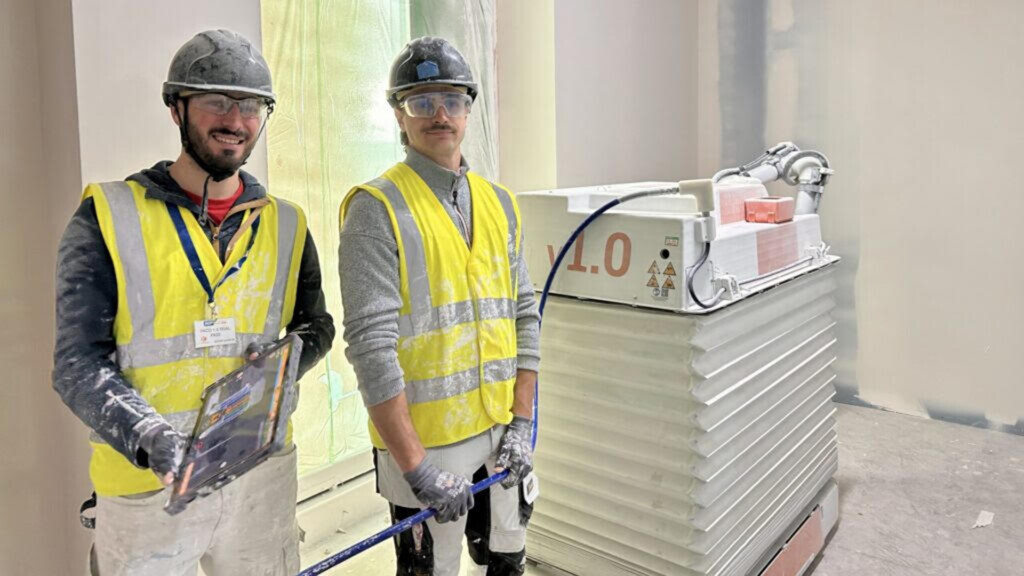
Robotics supports construction of healthcare facilities at Royal Shrewsbury Hospital
Construction technology is playing a role in the delivery of the new healthcare facilities at Royal Shrewsbury Hospital (RSH), where Integrated Health Projects (IHP) – the joint venture between VINCI Building and Sir Robert McAlpine – is using advanced digital systems and robotics to improve efficiency, quality and onsite safety.
Among the latest innovations now operational onsite is a specialist plastering robot developed by French company Les Companions. The PACO1.5v robotic system will operate across the hospital development for eight weeks, helping support plastering works throughout the infrastructure. The technology uses LiDAR scanning to assess rooms and identify suitable surfaces before spraying plaster to create a high-quality finish. The automated system is designed to support onsite teams by taking on repetitive and labour-intensive tasks, allowing skilled operatives to focus on more complex, technical work.
The specialised plaster robot forms part of a broader range of modern construction technologies being systematically deployed across the RSH project. These systems include digital field printers used to map out floor plans and building layouts, alongside precision cutting robots that reduce noise and dust while improving safety on-site. Furthermore, teams are using live construction mapping and digital coordination tools to support daily planning and subcontractor briefings, backed by enhanced site security technology designed to strengthen health and safety management.
Psyomics joins The Access Group’s Partner Programme
Digital health company Psyomics has joined The Access Group’s Partner Programme, enabling its specialised beseen platform to extend the functionality of its current integration with Access Rio EPR.
Access Rio EPR is the electronic patient record system currently used by half of the UK’s mental health trusts. This commercial and technical partnership is a step forward for NHS Mental Health Trusts looking to improve digital integration, reduce administrative burden on clinicians, and improve patient access to local services.
The integration development aims to ensure that comprehensive, patient-reported information collected through the beseen platform is made available within the Access Rio EPR ecosystem. This setup is being designed to support greater automation of routine medical administration, such as sending validated outcome measures, scoring responses and uploading results into the permanent patient record. Clinicians will then be able to view this data alongside other key metrics to support decision-making.
Psyomics’ technology captures detailed, patient-reported information, including self-reported symptoms, social factors and the wider determinants of health. By providing clinicians with a more holistic understanding of an individual’s needs before their first appointment, the platform supports more efficient pathways to care and improved overall system flow.
“By automating routine processes and enabling patient information to flow seamlessly into the clinical record, we can help services operate more efficiently and support clinicians to spend more meaningful time with patients,” said Melinda Rees, chief executive of Psyomics.
University Hospitals Sussex signs contract for EPR platform
University Hospitals Sussex NHS Foundation Trust (UHSussex) has signed a new seven-year agreement with healthtech provider Alcidion to supply its Electronic Patient Record (EPR) platform.
Alcidion’s modular Miya Precision platform will be deployed alongside Miya Observations and Assessments (Patientrack), a module that is already live and operational at the trust. Implementation of the comprehensive digital framework will begin immediately and is expected to take approximately two years, given the sheer breadth of the regional platform deployment.
With seven hospitals, UHSussex manages more than 1.5 million outpatient appointments, A&E visits and surgery cases a year, with a workforce of nearly 20,000 staff.
The rollout of Miya Precision will support the Trust’s structural transition from multiple disparate legacy systems into a single EPR, addressing historical challenges with data fragmentation and providing frontline clinical staff with intuitive tools to transform care delivery.
The scope of the modules includes virtual care capabilities, which is the first time an NHS Trust has included Alcidion’s Virtual Care module as a core part of its foundational EPR infrastructure. This system is designed to support the provision of remote care and continuous patient monitoring for individuals who may otherwise have required overnight treatment inside a physical hospital ward.
“UHSussex’s purpose for the EPR procurement is to implement a single, integrated digital platform that improves patient care, supports regional integration, drives operational efficiency and delivers long-term social and research benefits,” said Alcidion’s managing director and chief executive Kate Quirke.