Add us as a preferred source
The latest clinical innovations, including digital software rollouts, AI-driven preventative care pathways, a European first in robotic surgery, and newly expanded diagnostic facilities across the UK.
Reborne launches exclusive partnership with Circulate Health
London-based independent hospital Reborne has partnered with US biotechnology company Circulate Health. The agreement will see the Marylebone-based facility become the first European hospital to offer Circulate Health’s therapeutic plasma exchange (TPE) protocols.
TPE is an established medical procedure in conventional medicine in which blood plasma is separated from whole blood, filtered and replaced with a substitute fluid before being returned to the body. Performed under strict clinical supervision using US Food and Drug Administration (FDA) cleared apheresis technology, the treatment is delivered within a highly structured network. Growing interest in TPE reflects an increasing research focus on circulating factors in blood plasma – including inflammatory proteins, glycan patterns and environmental exposures such as microplastics – and their potential links to human ageing.
The UK rollout is structured to support longer periods of physical, cognitive and metabolic function.
“Our partnership with Circulate Health reflects a shared belief that longevity medicine should be held to the same standards as any serious science,” said Faye Mythen, consulting chief executive at Reborne. “Therapeutic plasma exchange has one of the strongest evidence trajectories in longevity medicine, and making it available through Reborne, alongside a team of this calibre, is exactly the kind of innovation we want to help bring to a wider audience.”

UHCW NHS Trust goes live with digital tech integration
University Hospitals Coventry and Warwickshire (UHCW) NHS Trust has launched an interoperable digital medicines management system, designed to cut nurse administration time and improve patient safety.
Funded by NHS England, the initiative integrates Omnicell’s automated dispensing cabinets and robotic dispensing systems directly with Oracle Health’s Electronic Patient Record (EPR). While this functionality has already been successfully deployed across healthcare networks in the US, this project marks its first implementation in England.
Previously, clinicians at the Trust had to navigate multiple separate, siloed systems to prescribe, locate and dispense medication. The new software establishes real-time visibility of stock levels across the entire hospital infrastructure directly within the patient’s EPR, detailing what is stocked on individual wards, what is available elsewhere and what needs to be ordered from the central pharmacy.
The software ensures that only active, clinically verified orders can be selected by staff, minimising the risk of delayed doses, omitted medications and human error. By supporting closed-loop medicines administration and barcode scanning, the platform enables verification and inventory optimisation across the hospital.
“For our nursing teams, this new system means they can begin a medication round knowing exactly where medicines are, how to obtain them, and that the process is both efficient and safe,” said Tracey Brigstock, chief nursing officer at UHCW.
Fit4Labour supports earlier identification of at-risk babies in labour
Safer Birth, a healthtech spinout from the University of Oxford, has launched Fit4Labour, a digital risk calculator designed to help clinicians identify babies at a higher risk of harm during labour.
The tool uses data from a historical database of over 71,000 births, and in clinical validation studies, the underlying algorithm successfully identified a third of the infants who were subsequently born with a brain injury.
The digital system delivers a comprehensive risk assessment at the onset of labour, providing an early warning an average of over eight hours before delivery. This enables midwives and obstetricians to plan around difficult births and avoid risky emergency procedures. By separating patients into distinct risk cohorts, the software highlights the highest-risk group that exhibits a rate of severe foetal compromise nine times higher than the lowest-risk group, giving frontline medical teams a resource to optimise clinical flow and prioritise the most vulnerable cases.
At the onset of labour, clinicians enter key data points into a user interface, including real-time maternal risk factors – such as whether the mother has pre-eclampsia or diabetes – alongside data from the cardiotocograph (CTG) foetal heart rate monitor. The software maps these inputs to generate a risk score in real time, supporting safer decision-making and clearer communication with families.
“Our simple and robust risk calculator can be used by obstetricians and midwives as they monitor women and their babies during the early stages of labour, removing the current variability in risk assessment,” said Antoniya Georgieva, co-founder of Safer Birth.

Bridgwater Community Diagnostic Centre achieves practical completion
Ergéa UK has completed construction of the new £17.8 million Bridgwater Community Diagnostic Centre (CDC), a healthcare facility for Somerset NHS Foundation Trust.
Building works were completed between January and March. Advanced diagnostic equipment was subsequently installed by early April, with completion on 12 June.
The project highlights the technical capabilities of Ergéa UK’s Managed Equipment Services model, which combines infrastructure delivery, medical technology procurement, equipment installation and lifecycle management within a single solution. While final clinical preparations will continue before patients are officially welcomed later this year, the expanded capacity is set to transform regional care.
“This milestone also marks the successful conclusion of Somerset’s Diagnostic Transformation Programme,” said David Craig, CDC director for Somerset. “I am incredibly proud of what the team has achieved and, most importantly, of the impact it will have for local people.”
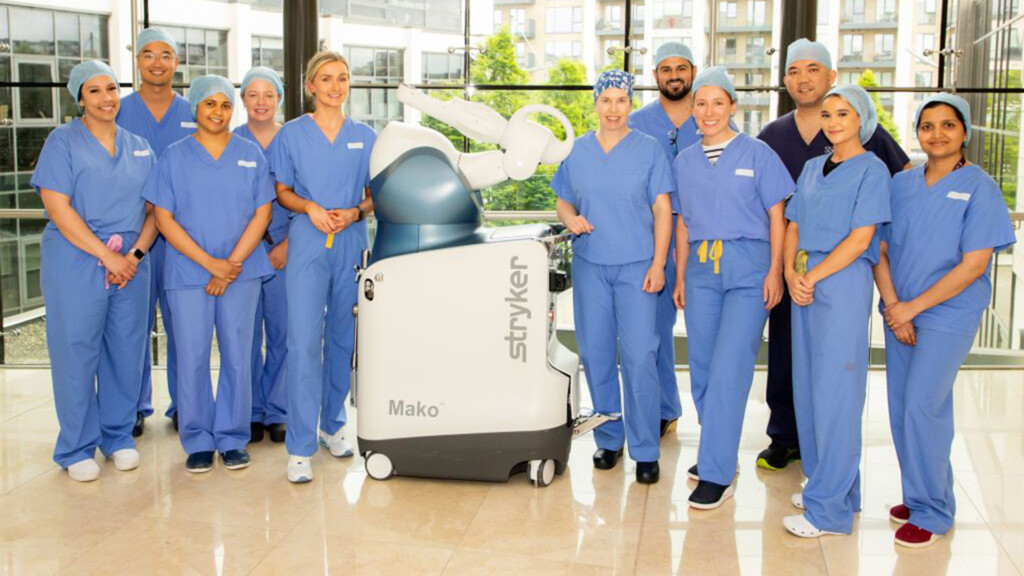
UPMC Sports Surgery Clinic completes Europe’s first Mako Shoulder procedure
The UPMC Sports Surgery Clinic has completed Europe’s first Mako Shoulder procedure, becoming the first hospital to use Stryker’s robotic-assisted technology for shoulder replacement surgery.
The specialised Mako Shoulder platform is designed specifically for reverse shoulder replacement procedures, combining Blueprint three-dimensional planning software, Stryker shoulder implants, and Mako SmartRobotics technology. The system enables orthopaedic surgeons to create a patient-specific surgical plan before entering the operating theatre, while providing real-time guidance and intraoperative feedback during the procedure itself.
To support implementation into clinical practice, the system is backed by Tekno Surgical, part of Uniphar Medtech, providing on-the-ground technical expertise.
The expansion into upper limb arthroplasty aims to assist surgeons in planning and executing complex joint replacements with consistency, predictability and anatomical precision.
“The completion of the first Mako Shoulder case in Europe represents an important milestone as robotic-arm assisted technology continues to expand into shoulder arthroplasty,” said consultant orthopaedic shoulder surgeon Ruth Delaney.
NHS in England has hit target of EPR systems in all acute hospitals
The NHS has reached near 100% coverage of Electronic Patient Record (EPR) systems across its acute hospital infrastructure, according to new industry data. For the first time in the history of the health service, every single English NHS hospital trust has now either installed, contracted for, or entered the formal process of procuring an EPR platform.
The findings, published by health IT market intelligence specialists Future Health Intelligence, signal a foundational achievement in the long-term digitisation of the national healthcare estate.
The milestone represents a critical phase of the “left-shift” to digital infrastructure, which was identified as one of three core strategic pillars in the Government’s 10-Year Plan for Health. EPRs serve as the central, foundational software networks used by hospitals to manage complex patient pathways, spanning admissions, discharge and transfers; ordering laboratory tests and diagnostic images; recording clinical medical notes; and prescribing medications. There has been a dramatic acceleration in deployment over the past three years. While 19 hospital trusts completely lacked an active EPR pathway in 2024, that figure dropped to eight last year and reached zero by March.
This rapid procurement activity was heavily galvanised by a target set in 2022 by the Department of Health and Social Care, which mandated 90% EPR coverage across hospitals and was backed by £3.4 billion of national funding. While US provider Epic and British supplier Nervecentre have secured the highest volume of new contracts over the last three years, procurement wins have been distributed across nearly all market vendors. The single largest contract finalised over the past 12 months was a £222 million shared EPR agreement awarded to Epic by a consortium of four trusts across Somerset and Dorset, highlighting a broader national push toward regional system convergence.
Powys Teaching Health Board goes live with digital medicines software
Powys Teaching Health Board (PTHB) has successfully gone live with the electronic prescribing and medicines administration (ePMA) software, Better Meds. This marks the beginning of a phased digital transformation programme across the Health Board’s secondary care services, replacing paper-based processes with a unified digital prescribing ecosystem.
The deployment is Better Med’s second live rollout in Wales – a following its introduction at Betsi Cadwaladr University Health Board – and forms part of the wider national Digital Medicines programme led by Digital Health and Care Wales (DHCW).
Crucially, Powys Teaching has become the first health board in Wales to use both read and write functionality with the Shared Medicines Record (SMR). This acts as a consolidated, shared repository of medicines, allergies and intolerances for all patients across Wales. By embedding this feature directly within the ePMA framework, clinicians can securely read current patient medications on hospital admission and write any changes made during care or at discharge back to the central record in real time.
The initial phase of the deployment took place on the Llewelyn ward at Bronllys Hospital, where inpatient staff transitioned away from traditional paper drug charts. For the rest of the year, the rollout will focus on inpatient wards across Powys community hospitals, with future phases scheduled to expand the connected platform into outpatient services, theatres and maternity care.
“It is exciting to see the SMR read and write functionality starting to be used within PTHB,” said Lesley Hewer, DHCW chair of the National ePMA Programme. “You can see the potential for this in Wales as being a game-changer; the jewel in the secondary care e-PMA implementation.”
Allergy Centre of Excellence opens first specialist clinic in the North of England
The Allergy Centre of Excellence (ACE) – the UK’s first specialist allergy hospital – will open its first clinic in the North of England, expanding its advanced diagnostic and treatment services beyond its primary London base.
Located in Stockport, Greater Manchester, the new clinical facility will specialise in comprehensive assessments, advanced diagnostics and targeted therapies for children with food allergic disorders. The hub will focus heavily on the delivery of Oral Immunotherapy (OIT), an evidence-based clinical pathway designed to desensitise paediatric patients to severe allergens.
OIT, which is also known clinically as Oral Tolerance Induction (OTI), is a physician-supervised treatment that involves the gradual, escalating introduction of specific allergens to build long-term physiological tolerance. The standardised therapeutic programmes typically take around six months to complete and are designed to reduce the risk of life-threatening allergic reactions, allowing families to manage food allergies with greater clinical confidence.
The expansion targets a major geographical gap in specialised healthcare infrastructure, offering complex OIT protocols that are not widely available either via the NHS or through private networks in the North of England. While the parent hospital in London’s Harley Street Health District has logged over 8,000 patient visits in its first nine months of operation, the Manchester site will initially focus on self-referral assessments for children aged 0-6 years who do not have a prior clinical history of anaphylaxis. Over time, the organisation plans to expand services to older paediatric cohorts and patients with more complex, elevated risk profiles.
“Bringing oral immunotherapy to the North-West will be a huge benefit to local families, and will provide peace of mind for parents and lifelong benefits for their children,” said Colin Bernstein, consultant paediatrician at the Allergy Centre of Excellence.

Puri Pharmacy launches AI-powered patient support partnership with Aide Health
Independent pharmacy group Puri Pharmacy is to partner with UK digital health company Aide Health to launch AI-powered patient support for individuals using medicated weight loss services. The software integration is designed to complement existing face-to-face clinician care, marking the first step in a broader digital healthcare rollout across the independent group’s network.
Family-owned Puri Pharmacy operates two clinical pharmacies across London in Southall and Hillingdon. Under the new model, patients enrolled in the provider’s medicated weight loss programme will receive access to conversational AI-supported health guidance and personalised digital toolkits alongside their in-person clinician care. The technology will provide patients with educational material – including critical guidance on protein intake and strength training while undergoing medicated weight loss – as well as interactive monitoring tools and automated medication reminders to optimise adherence.
Following the initial deployment within weight management pathways, Puri Pharmacy plans to expand the digital health platform into other major chronic conditions, including obesity, hypertension, and chronic obstructive pulmonary disease (COPD). The underlying conversational AI technology developed by Aide Health is already deployed across NHS England frameworks, backed by the National Institute for Health and Care Research (NIHR) and Innovate UK.
“Medicated weight loss should never be treated as a simple supply service,” said Rahul Puri at Puri Pharmacy. “We combine structured clinical oversight, face-to-face and remote consultations, personalised coaching and strong governance to help patients achieve safe, sustainable results.”

Medilink and 3M BIC to accelerate healthtech innovation
Medilink North of England and the 3M Buckley Innovation Centre (3M BIC) will collaborate to accelerate innovation, commercialisation and market adoption for health and medical technologies across Yorkshire and the North of England.
This formally links the 3M BIC and its sister site, the newly opened Health Business Innovation Centre (HBIC), with Medilink’s networks. The joint initiative establishes a streamlined entry point for regional healthtech firms to connect with NHS providers, venture capital investors and international markets.
The operational core of the partnership combines the technical infrastructure of the Huddersfield-based centres with Medilink’s consultancy services. Businesses will gain access to advanced prototyping and testing technologies – including additive manufacturing (3D printing), microscopy, X-ray Computed Tomography (XCT) and precision metrology – alongside targeted bid-sprint support to enhance funding success rates. For international and out-of-region organisations, the partnership will provide soft-landing services to assist them in establishing an operational footprint within West Yorkshire.
“At a time when Huddersfield and West Yorkshire are rapidly emerging as a hub for health innovation, this collaboration will strengthen our growing ecosystem,” said Henry Rigg, chief executive of the 3M BIC.
The partnership’s strategic objectives focus on enabling regional healthtech small and medium-sized enterprises (SMEs) and scale-ups to access specialised facilities and commercial routes to market. Joint operations will be governed by dedicated relationship managers and a quarterly steering group tracking key performance indicators, including corporate engagements, clinical and investor referrals, project conversion rates, regional funding secured, and local job creation.
The recently opened HBIC facility is situated in the Emily Siddon Building on the University of Huddersfield’s National Health Innovation Campus, operating as part of the Huddersfield Health Innovation Incubator backed by the West Yorkshire Investment Zone.
Stockport NHS Foundation Trust deploys Clinisys WinPath
Stockport NHS Foundation Trust has completed the full deployment of the Clinisys WinPath Laboratory Information Management System (LIMS). The final phase of the go-live, covering blood transfusion and blood sciences, was completed at the end of April. This follows an earlier successful implementation across microbiology and cellular pathology departments in September last year.
The introduction of WinPath replaces a legacy system that had been in use for over three decades. Clinicians and operational leads deliberately selected a phased approach to deployment to minimise operational risk while maintaining service continuity across high-demand diagnostic pathways. The trust’s pathology services operate at significant scale, processing more than 9.2 million tests annually in blood sciences alone, alongside over half a million microbiology tests, 140,000 cellular pathology slides, and 71,000 transfusion tests.
A component of the infrastructure project involved comprehensive, end-to-end testing, which included the safe migration of approximately 30 years of historical transfusion data into the new platform. To ensure accuracy and compliance with ISO standards prior to the live launch, project teams carried out large-scale data reviews and extensive case sampling. The implementation also forms part of the wider Greater Manchester LIMS programme.
“We made the decision early on to split the go-live into two phases to ensure patient safety and reduce risk,” said Mark Gordon, associate divisional director for pathology at Stockport NHS Foundation Trust. “Attempting a single implementation alongside other major changes, including analyser upgrades, would have been incredibly challenging.”